Insomnia often feels chaotic: long nights, unpredictable awakenings, and anxious guessing about what might finally work. Evidence-based insomnia treatment, especially Cognitive Behavioral Therapy for Insomnia (CBT‑I), brings gentle structure back into the picture.
A Structured Path Through Sleepless Nights
Think of this as a how-to manual for a calmer night routine—drawn from CBT‑I principles but presented in a flexible, at-home format. While this guide doesn’t replace professional care, it can help you build a more predictable path through the dark.
Step 1: Take a Two-Week Snapshot of Your Sleep
Before changing anything, pause and observe.
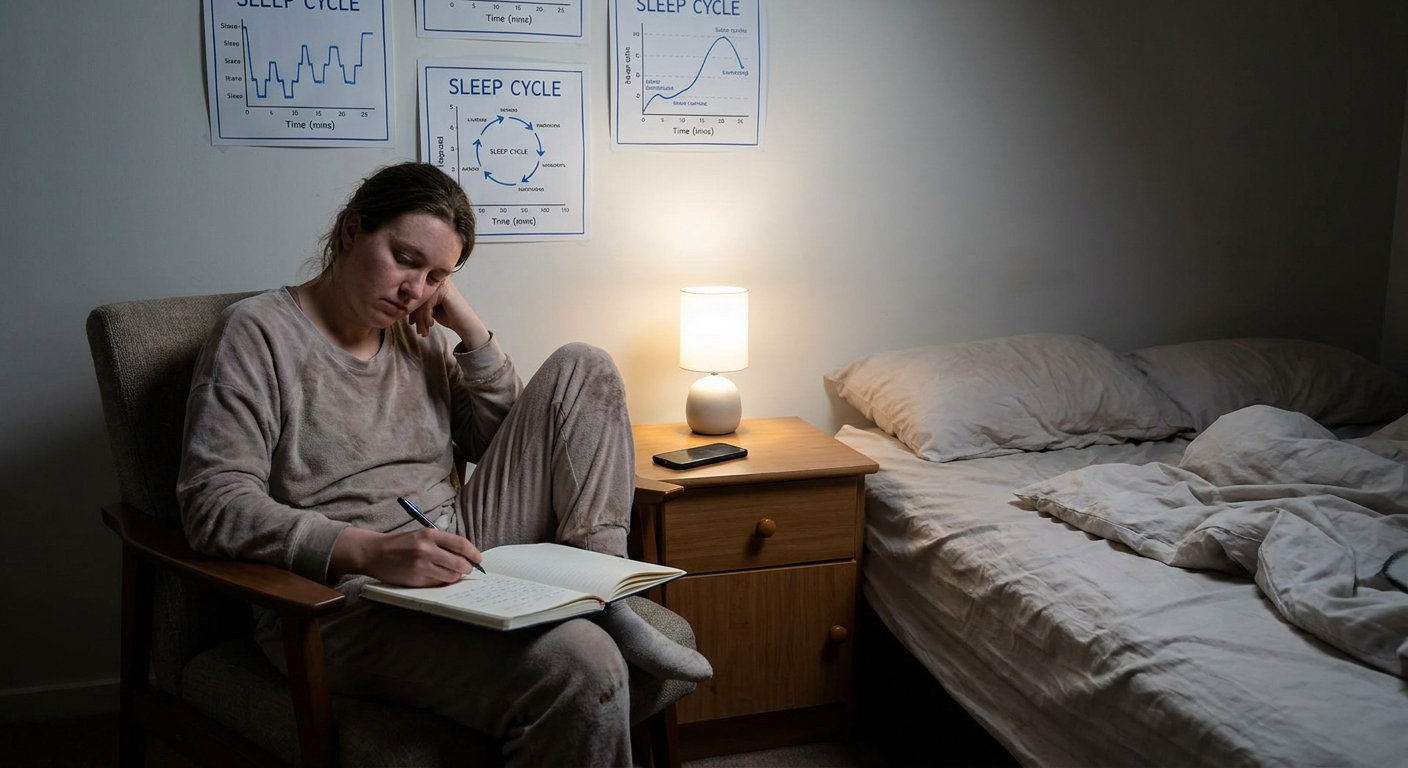
Keep a Simple Sleep Diary
For 14 days, each morning jot down:
- What time you went to bed
- Approximately how long it took to fall asleep
- How many times you woke up and for how long
- What time you woke up for the day
- Your overall sleep quality (1–5 scale)
This helps you:
- See patterns you may have missed
- Estimate your average total sleep time
- Avoid overly relying on one bad night as proof that “it’s always like this”
Sleep diaries are a standard part of CBT‑I and help tailor treatment.[^1]
Step 2: Set a Regular Wake Time (Your New Anchor)
The most powerful behavioral change for insomnia is not your bedtime—it’s your wake time.
Choose a time you can realistically maintain 7 days a week, allowing enough opportunity for future sleep (typically 7–9 hours in bed for most adults once insomnia improves). Commit to getting out of bed at that time regardless of the night you had.
Why this matters:
- It stabilizes your circadian rhythm
- It creates consistent sleep pressure (the longer you’re awake, the sleepier you eventually become)
- It reduces the “jet lag” effect from weekend catch-up sleep
Your wake time is the fixed point around which everything else will gently rotate.
Step 3: Match Time in Bed to Your Actual Sleep (Sleep Scheduling)
If you’ve been spending far more time in bed than you’re actually sleeping, your brain learns that bed = wakefulness. Sleep scheduling, derived from sleep restriction therapy in CBT‑I, aims to reverse this.[^2]
How to Do It Safely
- From your diary, calculate your average sleep time (e.g., 5.5 hours).
- Set your time in bed to roughly that amount + up to 30 minutes, but never less than 5 hours on your own.
- Example: If you sleep ~5.5 hours and choose 6 hours in bed with a 7:00 a.m. wake time → your target bedtime is 1:00 a.m.
For 1–2 weeks, stick to that window strictly:
- Go to bed at 1:00 a.m. - Get up at 7:00 a.m., even after a poor night.
Over time, your sleep becomes more efficient: less lying awake, more actual sleep.
> Important: If you have bipolar disorder, seizure disorders, untreated sleep apnea, or serious medical/psychiatric conditions, do this only under professional supervision.
When to Loosen the Window
Once your sleep efficiency (time asleep ÷ time in bed) is consistently above ~85% for a week or more, extend your time in bed by 15–20 minutes, keeping the same wake time and moving bedtime earlier.
This gradual process has been shown in multiple randomized controlled trials to reduce insomnia severity and maintain benefits months after treatment.[^2][^3]
Step 4: Create a 30–45 Minute Wind-Down Ritual
Sleep does not respond well to last-minute demands. A predictable, calming ritual tells your nervous system: “We’re shifting to a quieter gear now.”
Build Your Routine in Three Gentle Phases
Phase 1: Signal the Shift (10–15 minutes)
- Dim lights throughout your home.
- Put devices on Do Not Disturb.
- Do light organizing, pet care, or preparing clothes for tomorrow.
Phase 2: Body Soothing (10–15 minutes)
- Gentle stretching or yoga
- Warm shower or bath (60–90 minutes before bed is ideal)[^4]
- Skincare, brushing teeth, comfortable sleepwear
Phase 3: Mind Soothing (10–15 minutes)
Choose one non-stimulating activity:
- Reading a calming book (paper, not backlit)
- Listening to quiet music or an audiobook
- Light journaling (gratitude list, reflections)
Try to keep this sequence similar every night. Repetition is what turns a list of tasks into a ritual your body recognizes.
Step 5: Respond Differently to Awake Time in Bed
Insomnia is often fueled by how we react to wakefulness in bed. The CBT‑I principle of stimulus control helps break that cycle.[^5]
New Rules for the Bed
- Only go to bed when you are genuinely sleepy, not just when the clock says so.
- If you’re unable to sleep or return to sleep for about 20 minutes (no need to watch the clock), get out of bed.
- Go to a dim, quiet room and do something calm and low-stimulation:
- Read a neutral book
- Knit, draw, or do a light puzzle
- Listen to gentle audio
- Return to bed only when you feel drowsy.
You may repeat this several times in one night at first. It’s tiring—but it’s training. You’re teaching your brain that bed is for sleeping, not managing insomnia.
Step 6: Gently Work With Your Thoughts About Sleep
Thoughts like “I’m broken” or “I’ll be a wreck tomorrow” crank up physiological arousal.
A Simple Nighttime Thought Practice
When you notice a scary sleep thought, try three steps:
- Name it: “There’s the ‘catastrophe about tomorrow’ thought.”
Soften it: Ask, “Is there a more balanced version?”
- From: “I’ll be useless tomorrow.” To: “Tomorrow might be harder, but I’ve coped before.” 3. Refocus attention: Bring your attention gently to breath sensations, mattress contact, or sounds in the room.
This is adapted from cognitive restructuring and mindfulness approaches shown to help reduce insomnia-related distress.[^6][^7]
You’re not forcing positivity—just loosening the grip of worst-case thinking.
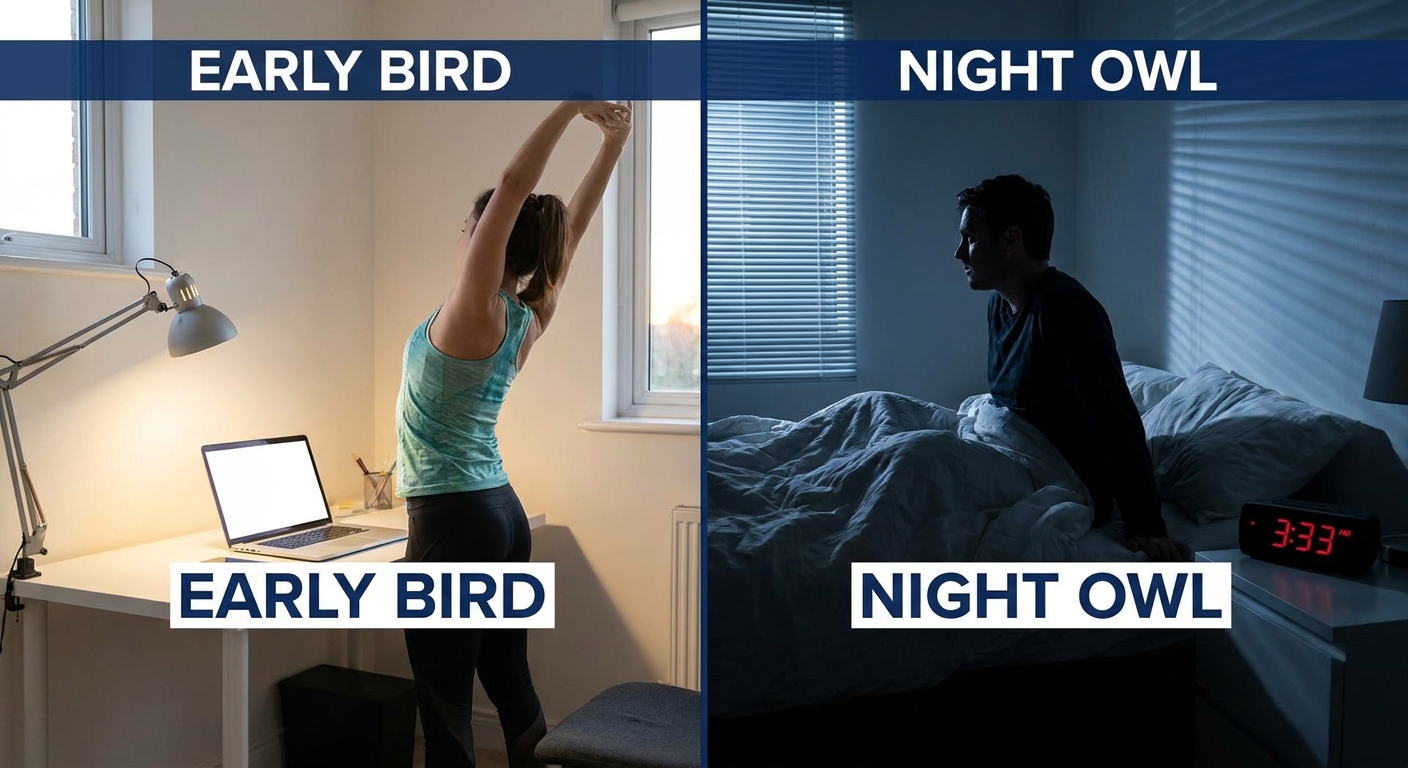
Step 7: Align Your Routine With Your Chronotype
Your routine should bend slightly toward your chronotype instead of breaking it.
If You Lean Morning-Type
- Place your wind-down ritual earlier (e.g., starting 9:00–9:30 p.m.).
- Get bright light within an hour of waking.
- Avoid naps later than mid-afternoon.
If You Lean Evening-Type
- Begin your ritual later, but at a consistent time (e.g., starting 11:00–11:30 p.m.).
- Maximize morning light exposure to gently nudge your rhythm earlier.
- Be realistic: going from a 1:30 a.m. bedtime to 10:00 p.m. overnight is too abrupt. Shift by 15–20 minutes every few days.
Research on chronotype shows that bringing schedules closer to natural tendencies, within life’s constraints, improves both sleep quality and daytime functioning.[^8]
Step 8: Stay With the Process Through Ups and Downs
Behavioral change for insomnia often follows a non-linear trajectory. Many people see initial improvements within 2–4 weeks of CBT‑I strategies, with more stable benefits emerging by 6–8 weeks.[^3]
You might notice:
- A brief worsening of sleep when you first reduce time in bed
- Emotional fatigue from getting out of bed multiple times when awake
- Occasional relapses during life stress
These do not mean it’s not working. They are common parts of the curve.
When to Add Professional Support
Enhancing your routine at home is valuable, but do consider formal CBT‑I or medical evaluation if:
- Insomnia has lasted 3+ months
- You snore loudly, gasp, or stop breathing during sleep
- You have intense nightmares or movements in your sleep
- You live with significant anxiety, depression, or PTSD
- You use alcohol, cannabis, or sedatives nearly every night to sleep
CBT‑I with a trained clinician, or through validated online programs, is recommended as first-line treatment for chronic insomnia by major sleep organizations.[^9]
A Quiet Encouragement
Sleep cannot be commanded, but it can be invited–patiently, predictably, night after night. Each part of this routine—your consistent wake time, limited time in bed, wind-down ritual, and new response to wakefulness—is a gentle signal to your brain: “You don’t have to stand guard all night.”
Your nights may not transform all at once, but they can soften, then slowly reweave themselves into something more reliable. You are rebuilding a skill your body once knew instinctively. With structure and self-compassion, that knowing can return.
[^1]: Carney CE, Buysse DJ, et al. The consensus sleep diary: standardizing prospective sleep self-monitoring. Sleep. 2012.
[^2]: Spielman AJ, Saskin P, Thorpy MJ. Treatment of chronic insomnia by restriction of time in bed. Sleep. 1987.
[^3]: Vitiello MV, Rybarczyk B, et al. Cognitive behavioral therapy for insomnia: effectiveness in older adults and long-term follow-up. Sleep Med Clin. 2013.
[^4]: Horne JA, Reid AJ. Night-time sleep EEG changes following body heating in a warm bath. Electroencephalogr Clin Neurophysiol. 1985.
[^5]: Bootzin RR. Stimulus control treatment for insomnia. Proc Am Psychol Assoc. 1972.
[^6]: Harvey AG. A cognitive model of insomnia. Behav Res Ther. 2002.
[^7]: Ong JC, Ulmer CS, Manber R. Improving sleep with mindfulness and acceptance. Cogn Behav Pract. 2012.
[^8]: Roenneberg T, Kantermann T, et al. Social jetlag and obesity. Curr Biol. 2012.
[^9]: Qaseem A, Kansagara D, et al. Management of chronic insomnia disorder in adults. Ann Intern Med. 2016.