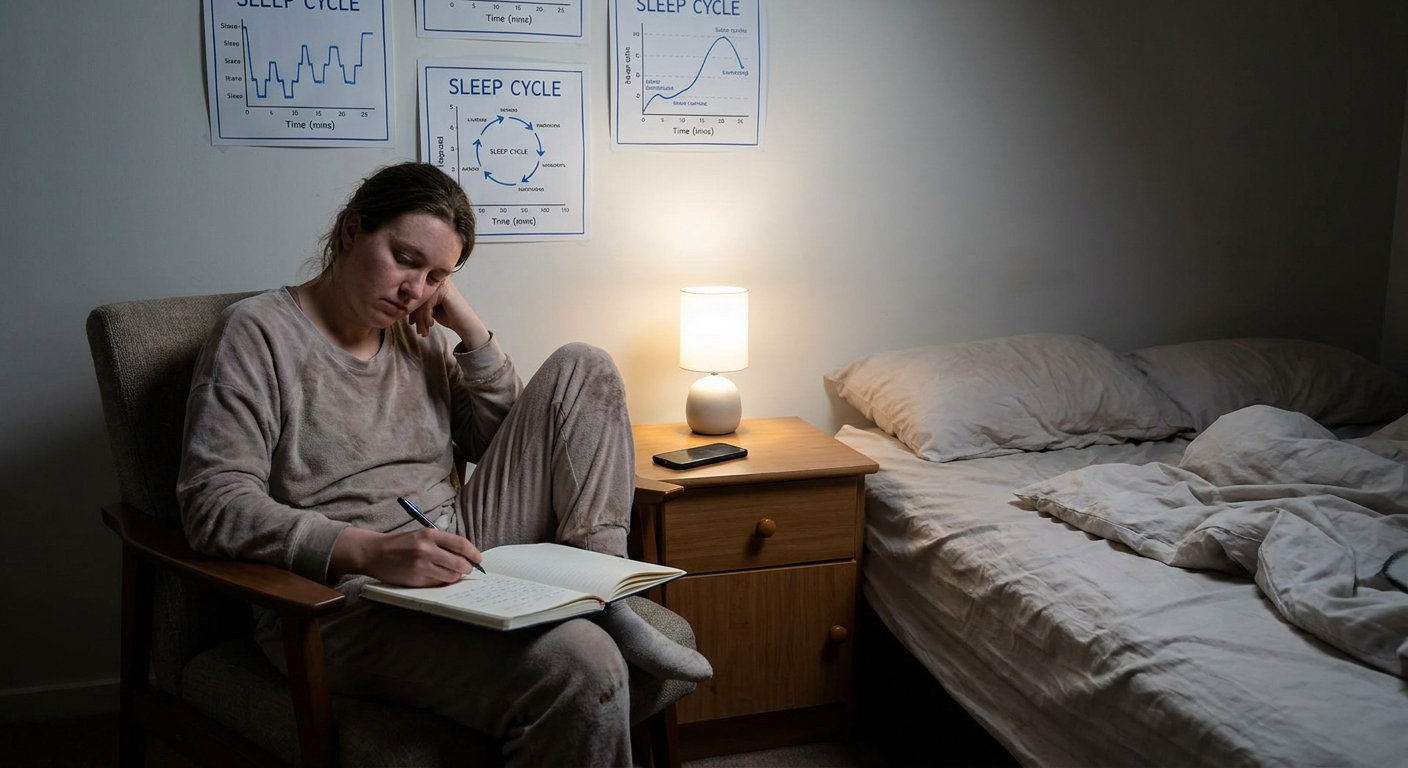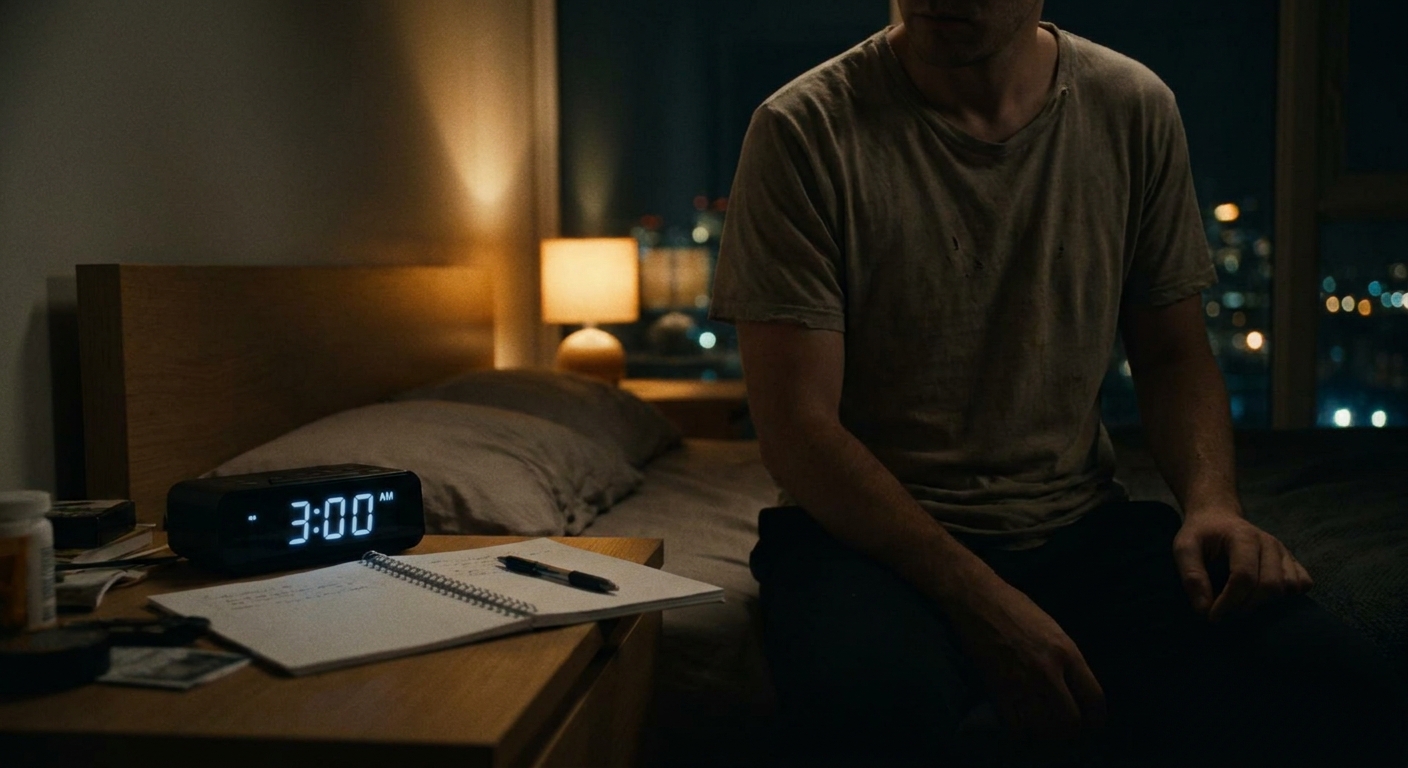
Every night, your senses ask the same question: “Is it safe to let go?” The bedroom answers. For people with insomnia, that answer is often mixed—part sanctuary, part stressor.
Your Room as a Sleep Signal
The encouraging news: relatively small, research-informed changes to your sleep environment can dial down arousal and make insomnia treatment more effective.[^1] Think of your bedroom as a soundstage; you can’t control when the actor (sleep) walks on, but you can adjust the lighting, set, and background noise to invite its entrance.
This guide focuses specifically on practical, environmental help for insomnia, with gentle nods to chronotypes so you can align your space with your body’s timing.
1. Light: The Director of Your Internal Clock
Light is the most powerful cue (zeitgeber) for your circadian rhythm.[^2] It can work for you or against you.
At Night: Dim the Evening
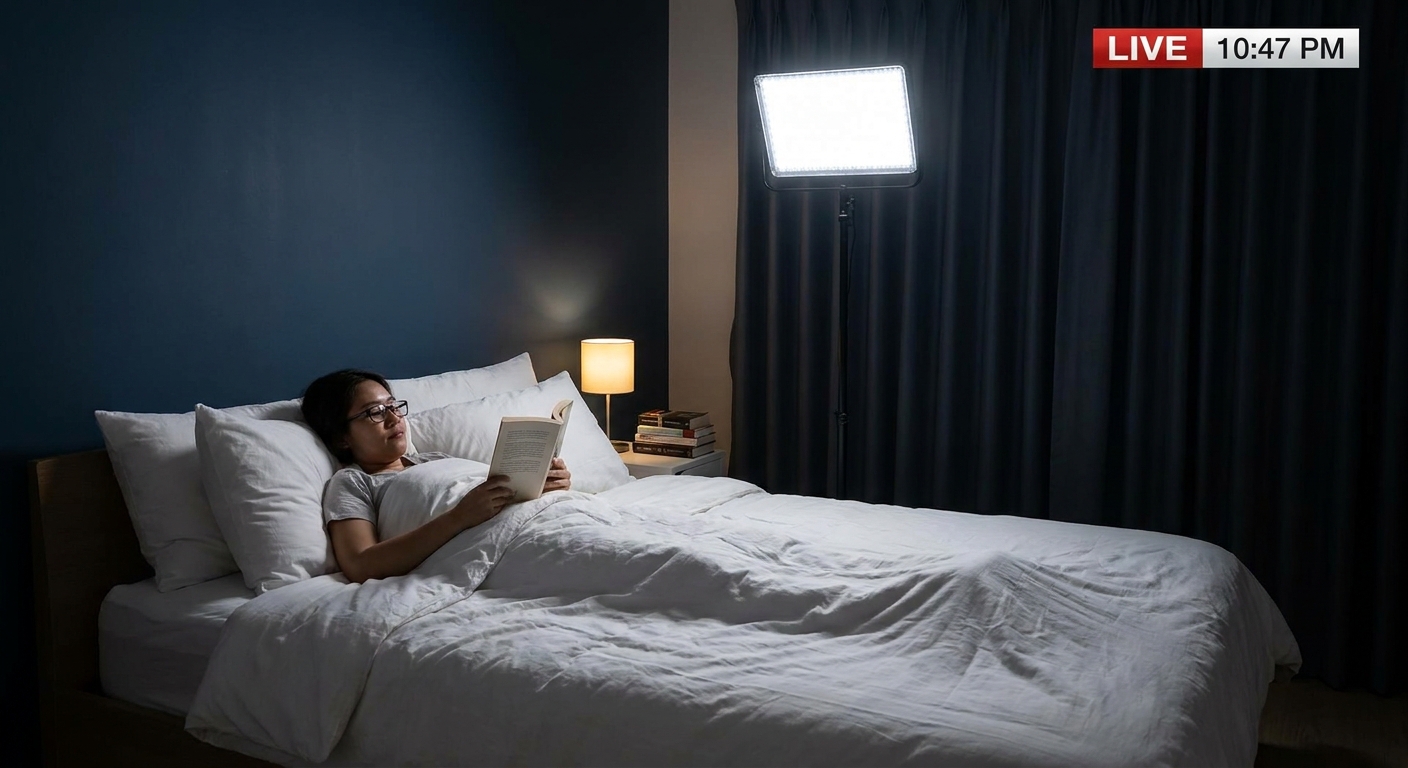
- Use warm, low-intensity lighting after sunset. Lamps with 2200–2700K bulbs are less disruptive than bright, cool-white overheads.
- Consider red or amber night-lights if you need light for the bathroom; these wavelengths have less impact on melatonin.
- Reduce bright screen exposure 60–90 minutes before bed. Blue-enriched light from phones and tablets can delay melatonin and increase alertness.[^3]
- If screens are unavoidable, use:
- Night mode or blue-light-reduction settings
- Lower brightness
- Greater distance from your eyes
In the Morning: Let the Day In
- Open curtains immediately upon waking.
- Spend 10–30 minutes outdoors within 1–2 hours of waking, even on cloudy days. Natural light is much stronger than indoor light and helps anchor your circadian timing.
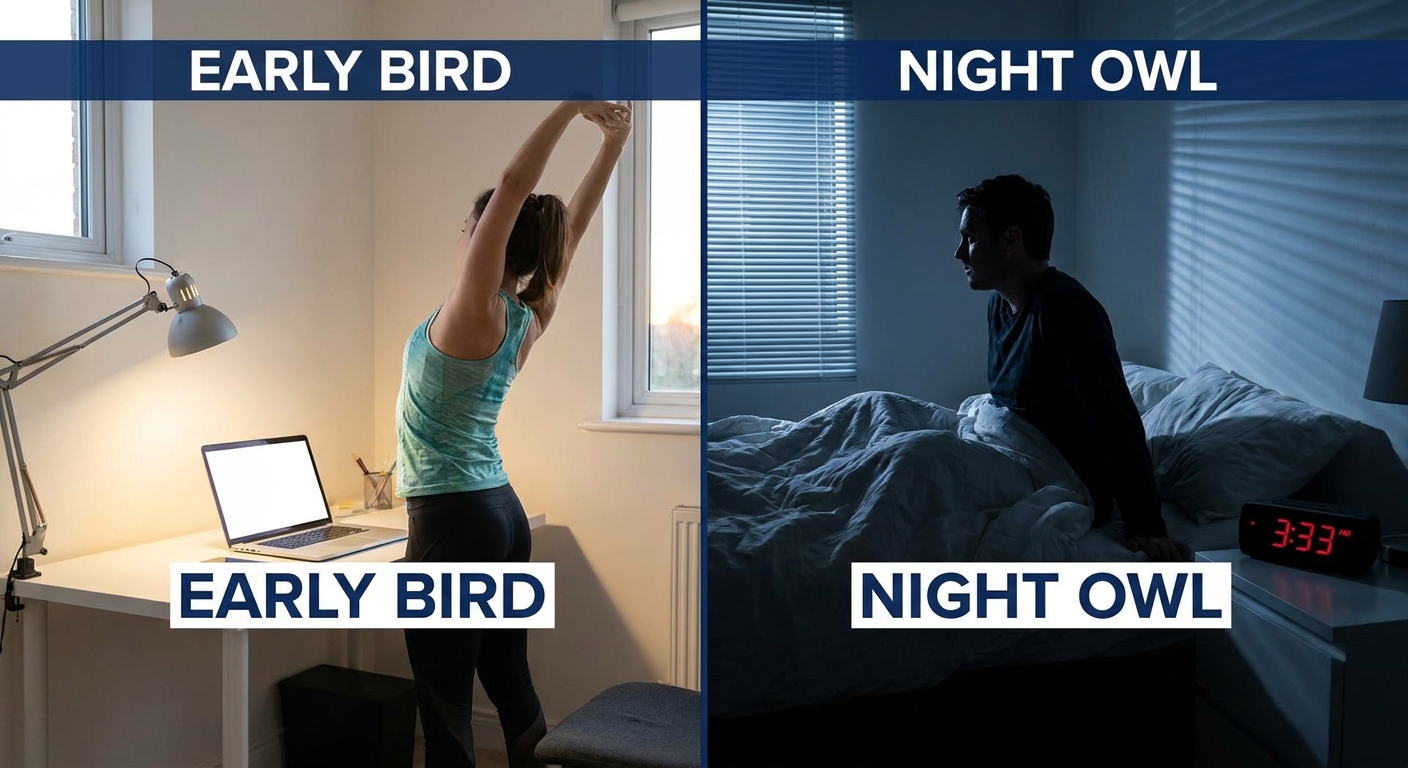
- Morning larks: Light is already on your side—maintain it.
- Night owls: Morning light is your best ally for shifting earlier gradually.
Imagine light as a conductor’s baton: evening dimming and morning brightness wave in “sleep” and “wake” at the right times.
2. Temperature: Cooling the Core for Easier Sleep
Your body naturally cools as you approach sleep; helping this process along can reduce sleep-onset latency.[^4]
Room Temperature and Bedding
- Aim for a bedroom temperature between 60–67°F (15–19°C).
- Choose breathable fabrics for sheets and sleepwear (cotton, bamboo, linen).
- Layer blankets so you can remove or add easily during the night.
Interestingly, mild distal warming (warming hands and feet) can actually help core temperature drop by dilating blood vessels.[^4] In practice:
- A warm bath or shower 60–90 minutes before bed can help you fall asleep faster.
- Light socks can keep feet warm without overheating your core.
Chronotype Note
- Evening types (night owls) may benefit from slightly later warm baths that coincide with their delayed natural drop in core temperature—but still within 1–2 hours of their planned bedtime.
- Morning types may prefer the earlier side of that 60–90 minute window.
3. Sound: From Startling to Soothing
Noise doesn’t have to be loud to disrupt sleep—inconsistency matters more.[^5] A car door slam at 3 a.m. can spike arousal in an otherwise quiet night.
Strategies to Neutralize Noise
- Use white noise, pink noise, or gentle nature sounds to create a consistent sound blanket.
- Consider earplugs if you tolerate them comfortably.
- For unavoidable sounds (e.g., partner’s snoring, city traffic):
- Move the bed away from shared walls or windows
- Use thick curtains or window inserts to dampen outside noise
Studies have found that consistent background sound can reduce nighttime awakenings and subjective sleep disturbance, especially in noisy environments.[^6]
Think of white noise as a soft rain that makes sudden sounds less jarring.
4. Visual Calm: Decluttering the Insomnia Triggers
Your eyes pick up more than you consciously notice. Stacks of paperwork, laundry piles, flashing devices—all can act as small stress signals.
Create a “Nothing Urgent” Zone
Try these steps bit by bit:
- Clear your nightstand of work items, bills, and notifications.
- Store non-sleep-related electronics (laptops, tablets) in another room at night.
- Use closed storage (drawers, baskets) for visual clutter.
- Position your bed so that when you lie down, your main view is soothing, simple, and non-demanding.
You’re sending your brain the message: “In this space, nothing needs to be accomplished.”
5. The Bed Itself: Comfort, Association, and Insomnia
Your mattress and pillows don’t have to be luxurious, but they should be supportive and not distracting.
Physical Comfort
- If you wake with aches or numbness, consider whether your mattress is too firm, too soft, or simply worn out.
- Pillow height should keep your neck aligned with your spine.
- For hot sleepers, mattress toppers with cooling properties may help.
Psychological Association
From an insomnia-treatment standpoint, how you use the bed matters as much as how it feels.
- Reserve the bed for sleep and intimacy only.
- Avoid working, eating, arguing, or watching intense media in bed.
- If you’re lying awake more than ~20 minutes, get up and go to a low-light, quiet space until drowsy.
These steps are central to stimulus control therapy, a core CBT‑I component shown to reduce sleep-onset latency and nighttime wakefulness.[^7]
Over time, your brain learns: “This surface means drifting, not thinking.”
6. Scents, Textures, and Small Rituals
Evidence on aromatherapy and insomnia is modest but suggests gentle benefits for some people.[^8] More important than any specific scent is the reliability of your pre-sleep ritual.
Consider:
- A light, calming scent (lavender, chamomile) if you enjoy it and are not sensitive.
- A favorite blanket or texture that feels comforting.
- A short, repeated sequence each night: dim lights → stretch → wash → read → lights out.
These cues become internal “breadcrumbs” leading your mind toward rest.
7. Chronotype-Aware Bedroom Routines
Your room can support your natural timing instead of fighting it.
If You’re a Morning Lark
- Keep your blinds slightly open if morning light won’t wake you too early; this reinforces your early rise.
- Dim your room earlier in the evening to align with your earlier melatonin rise.
- Finish stimulating tasks (bright screens, intense conversations) a bit earlier than others might need to.
If You’re a Night Owl
- Invest more in blackout curtains so early light doesn’t cut short what sleep you do get.
- Use bright indoor lighting in the early part of the evening, then gradually dim 1–2 hours before your planned bedtime.
- Shift your wind-down routine later, but keep it consistent—even if your bedtime is 12:30 rather than 10:30.
The goal isn’t to remake your chronotype overnight; it’s to create a bedroom that works with your clock while you make any gradual shifts needed for work or life obligations.
8. Putting It Together: A Sample “Sleep-Friendly Room Reset”
You don’t need to overhaul everything at once. Here’s a gentle, staged approach:
Week 1: Light and Devices
- Add one warm bedside lamp and commit to using only that after a set time.
- Move your phone to a dresser or another room; use a basic alarm clock.
- Experiment with a white noise app or machine.
- Adjust thermostat or bedding to reach a slightly cooler nighttime temperature.
- Clear surfaces in your direct line of sight from bed.
- Start the “bed only for sleep and intimacy” rule.
- Build a consistent 20–30 minute wind-down routine.
- Slightly adjust light exposure (morning vs evening) based on your chronotype.
Week 2: Sound and Temperature
Week 3: Declutter and Rededicate the Bed
Week 4: Ritual and Chronotype Alignment
A Quiet Reassurance
Improving your sleep environment won’t cure all insomnia on its own, but it creates fertile soil for other strategies—like CBT‑I, relaxation training, or medical treatments—to take root more easily.
Each tweak to your bedroom is a small note to your nervous system: “You are safe enough to drift.” Over time, those notes can become a chorus your body recognizes, even on nights when sleep still feels elusive.
Insomnia is a loud guest; your bedroom can learn to speak a softer language.
[^1]: Riemann D, Baglioni C, et al. The hyperarousal model of insomnia. Sleep Med Rev. 2010.
[^2]: Czeisler CA, Gooley JJ. Sleep and circadian rhythms in humans. Cold Spring Harb Symp Quant Biol. 2007.
[^3]: Chang A-M, Aeschbach D, Duffy JF, Czeisler CA. Evening use of light-emitting eReaders negatively affects sleep. PNAS. 2015.
[^4]: Van Someren EJW. Mechanisms and functions of coupling between sleep and body temperature rhythms. Prog Brain Res. 2006.
[^5]: Basner M, McGuire S. WHO environmental noise guidelines for the European Region. Int J Environ Res Public Health. 2018.
[^6]: Stanchina ML, Abu-Hijleh M, et al. The influence of white noise on sleep in subjects exposed to ICU noise. Sleep Med. 2005.
[^7]: Bootzin RR, Perlis ML. Stimulus control therapy. In: Treatment of Sleep Disorders. Springer; 1992.
[^8]: Hwang E, Shim M, et al. Effects of aromatherapy on sleep quality: a systematic review. J Korean Acad Nurs. 2015.