Deep beneath your busy thoughts, a quiet clock is ticking. It does not measure minutes or deadlines—it keeps time with light and darkness, body temperature, hormones, and the ebb and flow of sleepiness. This inner timekeeper is your circadian rhythm, and learning its language can feel like finally exhaling after a long day.
Listening to the Quiet Clock Inside You
In this guide, we’ll explore how this clock works, what the research tells us, and how to gently realign your days and nights so sleep feels more like a tide coming in than a battle you must win.
What Is Circadian Rhythm, Really?
Your circadian rhythm is a roughly 24-hour cycle in physiology and behavior that repeats each day. The word "circadian" comes from the Latin circa diem—"about a day." Almost every cell in your body has a clock, but at the center is the master clock in your brain: the suprachiasmatic nucleus (SCN), a tiny region in the hypothalamus.
This master clock:
- Receives light signals from your eyes
- Coordinates daily rhythms in body temperature, hormone release, digestion, and alertness
- Helps determine when you naturally feel awake and when sleepiness gently settles in
Research shows that disrupting this clock—through irregular schedules, late-night light, or frequent time zone changes—can impair sleep, mood, and even metabolic health.[^1][^2]
How Light Sets the Pace of Your Inner Clock
Light is the primary time cue ("zeitgeber") for your circadian rhythm. Special light-sensitive cells in your eyes, called intrinsically photosensitive retinal ganglion cells (ipRGCs), send signals directly to the SCN.
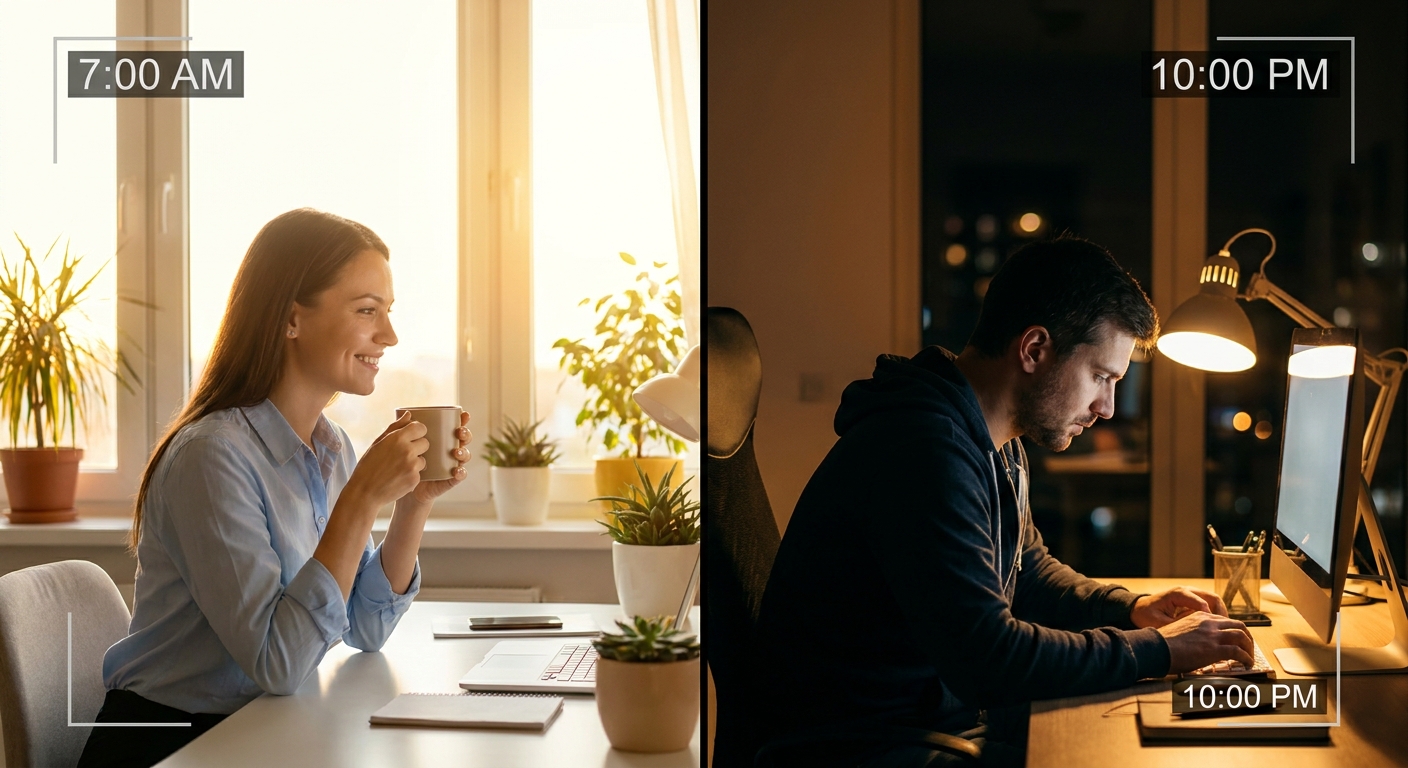
- Morning light (especially blue-enriched daylight) shifts your clock earlier, helping you feel sleepy sooner at night.
- Evening light (particularly bright, cool, blue-rich light from screens and LEDs) shifts your clock later, making it harder to fall asleep.
Studies show that even moderate evening light can suppress melatonin—the hormone that signals the body to prepare for sleep—and delay sleep onset.[^3] At the same time, consistent morning light exposure improves sleep quality and stabilizes circadian timing.[^4]
Think of light as the conductor’s baton, setting the tempo for your internal orchestra.
The Daily Rhythm: Body Temperature, Hormones, and Sleepiness
Circadian science reveals that many of your internal processes follow a predictable arc:
- Cortisol often peaks in the early morning, helping you wake and feel alert.
- Body temperature tends to be lowest in the early morning hours and highest in the late afternoon to early evening.
- Melatonin is usually secreted in the evening under dim light, rising as your sleepiness grows.
When these rhythms align—melatonin rising as temperature drops, cortisol falling toward night—sleep comes more easily and feels more restorative.[^5] When they fall out of sync (for example, staying under bright light late at night), your body can feel like an orchestra playing slightly out of tune.
Understanding Your Chronotype: Larks, Hummingbirds, and Owls
Your chronotype is your natural tendency to feel more alert in the morning, evening, or somewhere in between. This isn’t laziness or virtue—it’s biology.
Researchers often describe three broad groups:[^6]
- Morning types (larks) – Prefer earlier bed and wake times; feel most alert earlier in the day.
- Intermediate types (hummingbirds) – Fall somewhere in the middle; relatively flexible.
- Evening types (owls) – Naturally more alert later in the day; struggle with early mornings.
Chronotype is influenced by genetics, age, and environment. Teenagers, for example, tend to shift later (more “owl-like”), while many older adults shift earlier.
The key is not to fight your chronotype, but to gently guide it so your responsibilities and biology can coexist.
Calming, Practical Bedroom Changes Aligned with Circadian Science
Think of your bedroom as a cue to your inner clock—a physical signal that the day is softening into night.
1. Soften the Evening Light
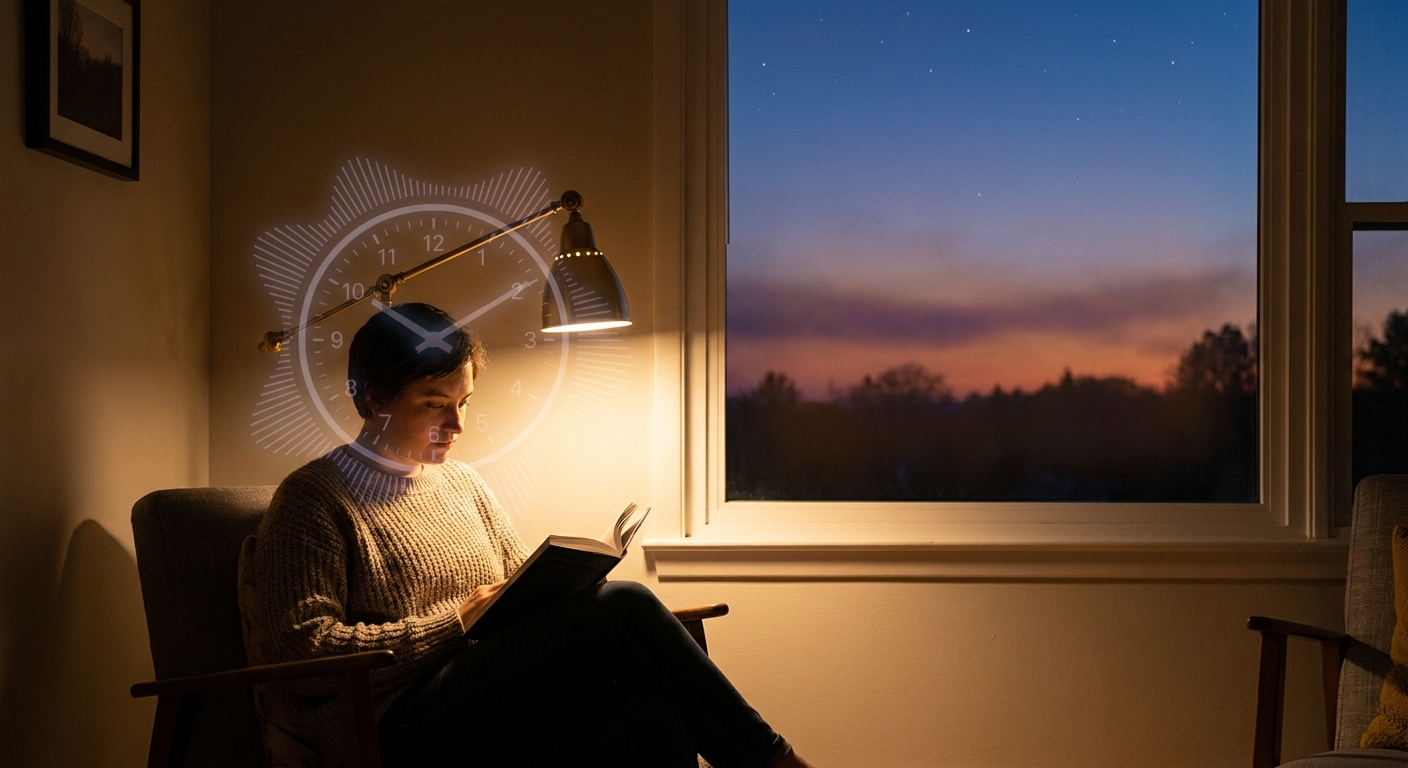
- Use warm, dim bedside lamps (2700K or lower) in the hour or two before bed.
- Add dimmers where possible.
- Turn off overhead bright, cool-toned LEDs by late evening.
Research shows that dim, warm lighting in the evening allows normal melatonin rise and supports earlier sleep onset.[^3]
2. Darken the Night
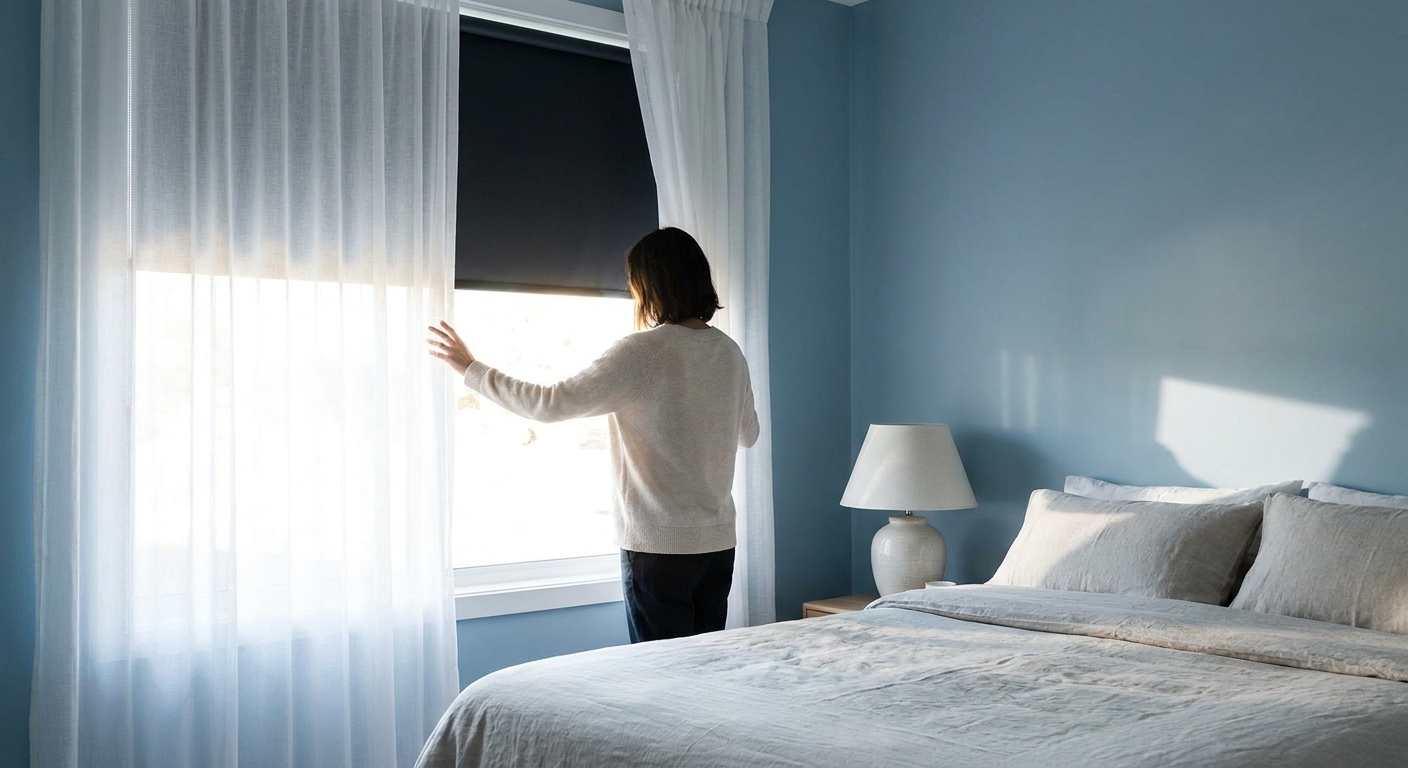
- Install blackout curtains or use a sleep mask to block outdoor light.
- Cover or tape over small LEDs on chargers and devices.
Darkness tells your SCN that night has arrived. Even small amounts of light during sleep can reduce melatonin and fragment sleep.[^7]
3. Cool and Quiet as a Cave
Your body temperature drops at night as part of circadian rhythm. A cool room supports this natural dip.
- Aim for a bedroom temperature of about 60–67°F (15–19°C).[^8]
- Use breathable bedding and fabrics.
- If noise is an issue, consider white noise or soft fan noise to create an auditory buffer.
4. Declutter the Visual Noise
Mess can feel like mental static. A calmer space signals "this is a place for rest, not tasks."
- Keep surfaces near the bed largely clear.
- Move work-related items (laptops, documents) out of sight if possible.
While clutter isn’t a biological zeitgeber, it can stimulate mental activity and stress—subtle nudges away from the restful state that invites sleep.
Chronotype-Specific Evening Routines
Different inner clocks need slightly different evening rituals.
If You’re a Morning Type (Lark)
Your challenge: Waking too early or getting sleepy too soon.
Gentle strategies:
- Evening light: Allow some moderate, warm light in early evening; avoid excessively dim environments hours before bedtime so you don’t become sleepy at 7–8 p.m.
- Activity timing: Plan stimulating conversations, reading, or light hobbies in the earlier evening to sustain wakefulness.
- Wind-down: Begin a calm routine about 60–90 minutes before your target bedtime, not much earlier.
If You’re Intermediate (Hummingbird)
Your challenge: Balancing responsibilities with natural patterns.
Gentle strategies:
- Consistency: Keep a steady wake time, even on weekends (with at most a 1-hour difference). This stabilizes your circadian rhythm.[^9]
- Light: Seek at least 30 minutes of outdoor light each morning to anchor your clock.
- Evening: Dim lights 1–2 hours before bed; avoid stimulating activities or troubleshooting life problems late at night.
If You’re an Evening Type (Owl)
Your challenge: Feeling wide awake at night yet required to wake early.
Gentle strategies:
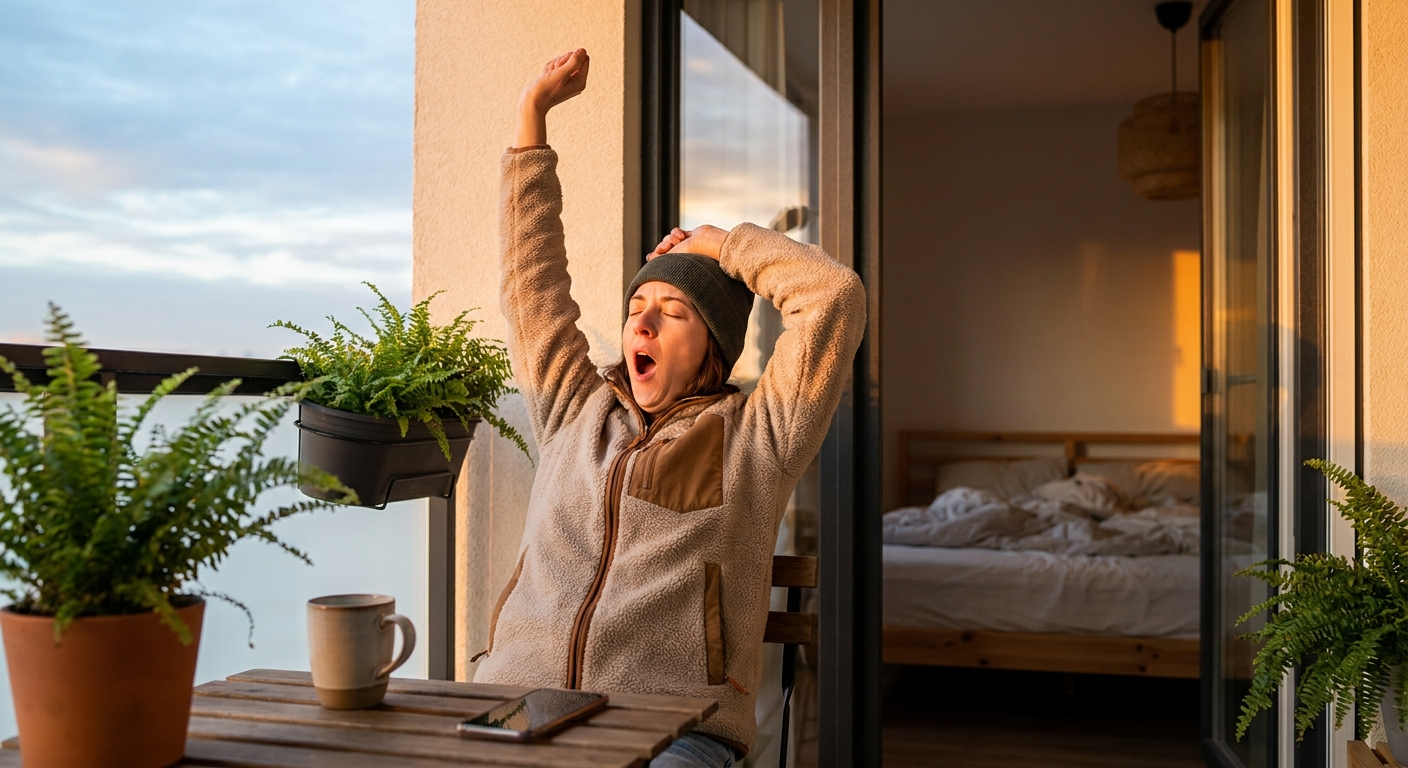
- Morning light therapy: Aim for 30–60 minutes of bright morning light soon after waking—ideally outdoors. This can gradually shift your clock earlier.[^4]
- Limit late-night light: Use blue-light filters on devices, or better, step away from screens in the hour before bed.
- Gradual shifting: Move your bedtime and wake time earlier by 15–30 minutes every few days, paired with consistent morning light.
Research suggests that structured morning light, regular wake times, and earlier meal timing can meaningfully help evening types align with conventional schedules.[^10]
Gentle Encouragement: You Are Not Broken, You Are Mis-Timed
If sleep feels elusive, it’s easy to feel as though something is wrong with you. Circadian science offers a kinder story: often, there is a mismatch between your internal time and the external demands of work, culture, or habits.
With patient adjustments—like turning down the lights in the evening, inviting in the morning sun, and respecting your chronotype—you are not forcing your body, you are inviting it back into rhythm.
Progress often comes in small, almost invisible increments:
- Falling asleep 10–15 minutes earlier
- Waking a little more refreshed
- Feeling sleepiness arrive more predictably
These are signs that your quiet clock is beginning to tick in harmony again.
Let each evening be a soft closing of the day, and each morning a gentle opening. Over time, your inner clock will remember the rhythm it was always meant to keep.
References
[^1]: Czeisler CA et al. Stability, precision, and near-24-hour period of the human circadian pacemaker. Science. 1999.
[^2]: Zee PC, Attarian H, Videnovic A. Circadian rhythm abnormalities. Continuum (Minneap Minn). 2013.
[^3]: Chang AM et al. Evening use of light-emitting eReaders negatively affects sleep, circadian timing, and next-morning alertness. PNAS. 2015.
[^4]: Khalsa SBS et al. A phase response curve to single bright light pulses in human subjects. J Physiol. 2003.
[^5]: Dijk DJ, Czeisler CA. Contribution of the circadian pacemaker and the sleep homeostat to sleep propensity, structure, and EEG power density. J Neurosci. 1995.
[^6]: Roenneberg T, Wirz-Justice A, Merrow M. Life between clocks: daily temporal patterns of human chronotypes. J Biol Rhythms. 2003.
[^7]: Cho CH et al. Effects of artificial light at night on human health: A literature review of observational and experimental studies. Chronobiol Int. 2015.
[^8]: Okamoto-Mizuno K, Mizuno K. Effects of thermal environment on sleep and circadian rhythm. J Physiol Anthropol. 2012.
[^9]: Wittmann M, Dinich J, Merrow M, Roenneberg T. Social jetlag: misalignment of biological and social time. Chronobiol Int. 2006.
[^10]: Facer-Childs ER, Middleton B, Skene DJ, Bagshaw AP. Resetting the late timing of ‘night owls’ has a positive impact on mental health and performance. Sleep Med. 2019.