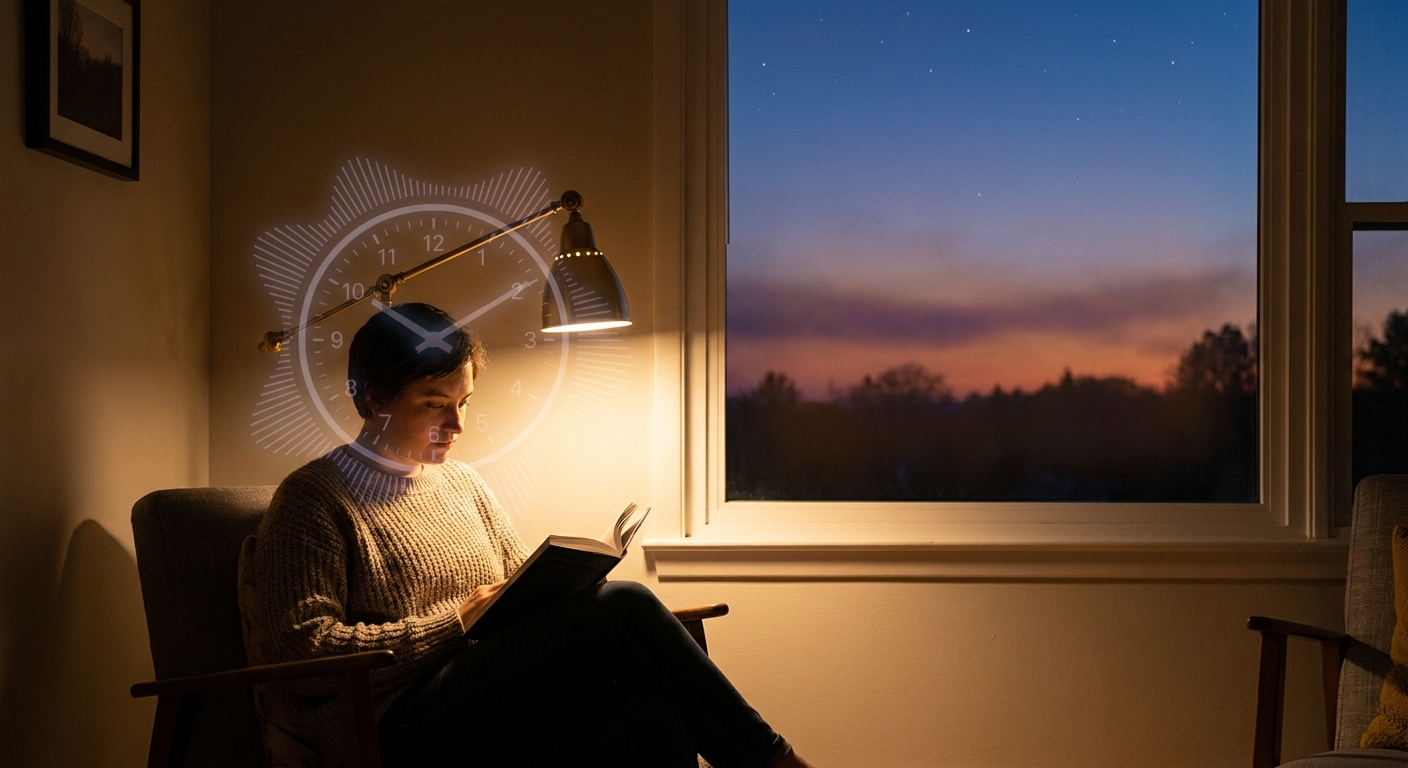
There are seasons of life when your sleep feels slightly out of step—bedtime drifts later, mornings arrive too soon, and fatigue becomes a constant background hum. This state of misalignment between your internal clock and the outside world can feel like a kind of quiet jetlag, even when you haven’t stepped on a plane.
When Your Days and Nights Feel Off‑Key
The encouraging truth from circadian science is that your inner clock can be reset. Not overnight, and not by force—but through consistent, gentle cues. This guide offers a practical, evidence-based plan to help you realign your rhythm, tailored to different chronotypes and grounded in daily routines and simple bedroom changes.
Step 1: Understand What You’re Resetting
Your circadian rhythm is governed by a master clock in the brain—the suprachiasmatic nucleus (SCN)—which keeps time using cues such as light, meals, activity, and social interactions.[^1]
When your sleep schedule is irregular, when you stay under bright light late into the evening, or when you frequently shift your routine, this clock can drift away from the day–night cycle in your environment. That drift is what many people experience as being “off” or “wired at night, flat in the morning.”
Re-entrainment—bringing your inner time back in line with the external day—is possible through carefully timed adjustments.
Step 2: Choose Your Target Schedule (Realistically)
Before making changes, decide on a realistic target schedule that respects both your life and your chronotype.
Ask yourself:
- What is the earliest wake time I truly need on most days?
- Given my chronotype, what bedtime would allow 7–9 hours of sleep and still feel somewhat natural?
For a strong evening type, a 9 p.m. bedtime may not be feasible immediately; a gradual shift toward 11 p.m., then 10:30, and so on, will be more sustainable.
Write down your target sleep window (e.g., 11 p.m.–7 a.m.). This will be the shore toward which you gently steer.
Step 3: Use the Most Powerful Lever—Light
Light is the main tool you’ll use to reset your circadian rhythm.[^2]
Morning: Pull Your Clock Earlier
If you want to fall asleep and wake earlier:
- Get bright light (ideally outdoors) for at least 30 minutes within the first 1–2 hours after waking.[^3]
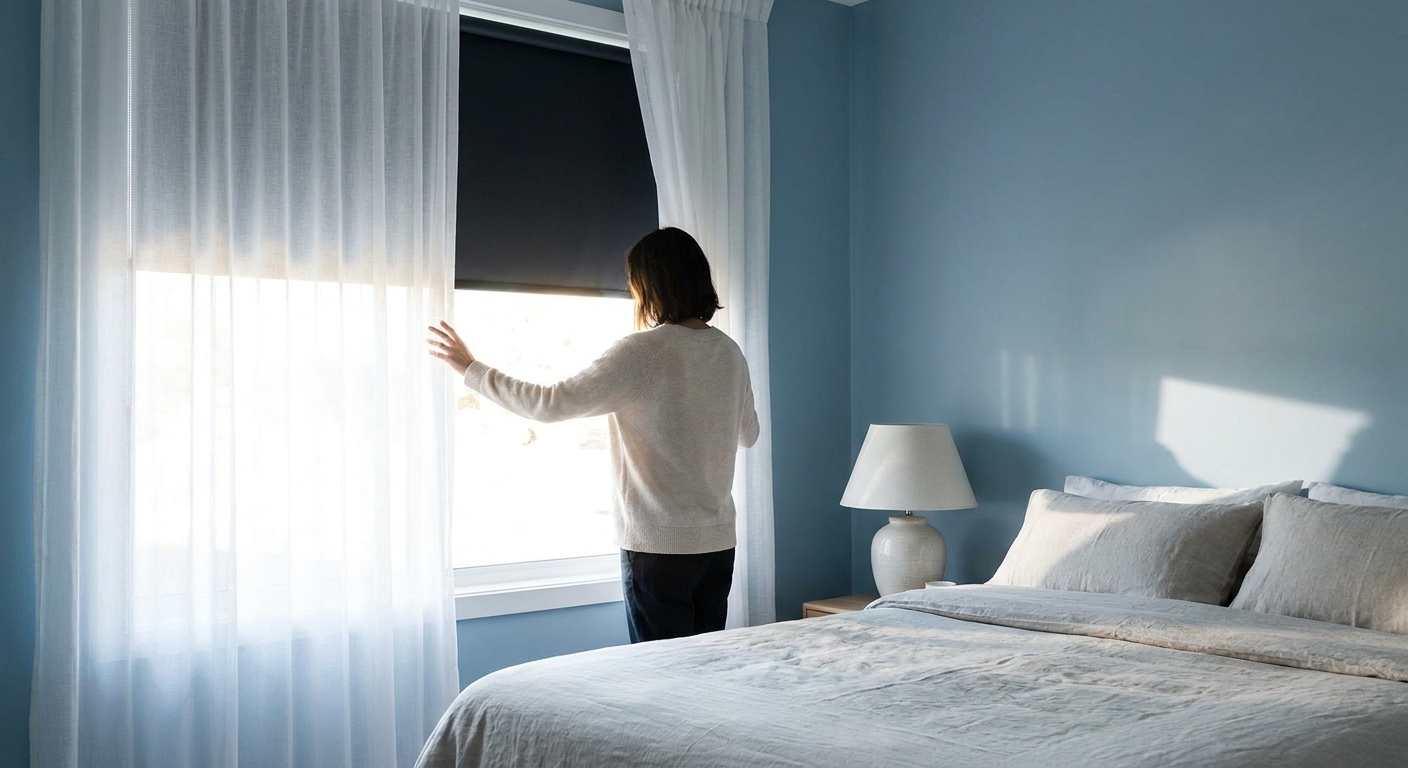
- Open curtains fully and, if possible, spend time near a window or outside.
- Keep indoor lighting bright and cool-toned for the first half of the day.
Evening: Allow Night to Arrive
If you’re aiming for an earlier bedtime:
- Start dimming lights 2 hours before your target bedtime.
- Switch to warm, low-intensity lamps; avoid bright overheads.
- Use blue-light filters on devices, reduce screen brightness, and increase distance from your face.
Studies show that reducing evening light exposure allows melatonin to rise on schedule and improves sleep onset.[^4]
Step 4: Shift Your Schedule Gradually
Your internal clock doesn’t jump; it glides.
- Adjust bedtime and wake time by 15–30 minutes every 2–3 days, not hours at once.
- Keep your wake time non-negotiable; your body will gradually pull your bedtime earlier to compensate.
- Maintain this wake time even on weekends, allowing at most a 1-hour variation.[^5]
This consistency reduces “social jetlag,” the misalignment between your biological and social clocks.
Step 5: Align Meals, Movement, and Bedroom Environment
Your circadian system also listens to when you eat, move, and retreat to your bedroom.
Time Your Meals
- Aim to eat the majority of your calories during daylight hours.
- Finish large meals 2–3 hours before bed; late heavy eating can delay sleep and affect metabolic rhythms.[^6]
Move with the Day
- Schedule moderate physical activity in the morning or afternoon.
- Intense exercise too close to bedtime can delay sleep for some people by raising core body temperature and arousal.
Prepare the Bedroom
Transform your bedroom into a night signal:
- Keep it cool (about 60–67°F / 15–19°C).[^7]
- Use blackout curtains or a sleep mask to maintain darkness.
- Remove or cover distracting LEDs.
- Reserve the bed primarily for sleep and calm activities.
Step 6: Tailor the Plan to Your Chronotype
Different starting points benefit from different emphases.
For Morning Types (Larks)
Goal: Often, to avoid drifting too early and to reduce early-morning awakenings.
- Use moderate evening light (still warm and not harsh) to avoid excessively early sleepiness.
- If you consistently wake before your desired time, allow a little morning light delay by keeping blinds partially closed for the first half-hour.
- Keep stimulating tasks (email, planning) in the earlier part of the day; let evenings be for softer activities.
For Intermediate Types (Hummingbirds)
Goal: Stabilize sleep timing and prevent gradual drift.
- Set a firm wake time that suits your life and hold it steady.
- Reduce weekday–weekend gaps; this alone can markedly improve how rested you feel.[^5]
- Use a short, consistent wind-down ritual to cue your brain that sleep is approaching.
For Evening Types (Owls)
Goal: Gradually shift the clock earlier and reduce morning suffering.
- Prioritize bright morning light relentlessly; think of it as a daily appointment with your circadian system.
- Avoid bright light in the hours before target bedtime as if you were avoiding caffeine—light is a stimulant for your clock.[^2]
- Be patient. Studies show that even strong interventions shift circadian phase by about 30–60 minutes per day.[^3]
A Sample 10-Day Gentle Reset Plan (For a Moderate Night Owl)
Initial pattern: 1 a.m.–9 a.m.
Target pattern: 11 p.m.–7 a.m.
Days 1–3:
- Wake at 8:30 a.m. (even on days off).
- Get 30–45 minutes of outdoor light by 10 a.m.
- Dim lights from 11 p.m., in bed by 12:30 a.m.
Days 4–6:
- Wake at 8:00 a.m..
- Morning light before 9:30 a.m.
- Dim lights from 10:30 p.m., in bed by 12:00 a.m.
Days 7–8:
- Wake at 7:30 a.m..
- Morning light before 9:00 a.m.
- Dim lights from 10:00 p.m., in bed by 11:30 p.m.
Days 9–10:
- Wake at 7:00 a.m..
- Morning light before 8:30 a.m.
- Dim lights from 9:30 p.m., in bed by 11:00 p.m.
Adjust as needed, but maintain the philosophy: steady wake time, gentle shifts, and consistent light cues.
Compassion as a Circadian Tool
Perhaps the most overlooked aspect of resetting your rhythm is how you speak to yourself as you do it.
There will be nights when sleep is stubborn and mornings when the alarm feels unkind. That does not mean the effort is failing. Circadian systems change slowly, like a tide reshaping the shoreline. What matters most is persistence, not perfection.
Each evening you dim the lights when you’d rather push on, each morning you open the curtains when you’d rather hide, you’re sending a clear, consistent message to your inner clock: this is the new rhythm. Over days and weeks, your biology begins to listen.
Allow yourself the space to move gradually. In honoring your circadian system with steady cues and a calm environment, you invite sleep to arrive not as an enemy you’ve conquered, but as a trusted visitor who knows exactly when to knock.
References
[^1]: Hastings MH, Reddy AB, Maywood ES. A clockwork web: circadian timing in brain and periphery, in health and disease. Nat Rev Neurosci. 2003.
[^2]: Czeisler CA, Gooley JJ. Sleep and circadian rhythms in humans. Cold Spring Harb Symp Quant Biol. 2007.
[^3]: Khalsa SBS et al. A phase response curve to single bright light pulses in human subjects. J Physiol. 2003.
[^4]: Chang AM et al. Evening use of light-emitting eReaders negatively affects sleep, circadian timing, and next-morning alertness. PNAS. 2015.
[^5]: Wittmann M, Dinich J, Merrow M, Roenneberg T. Social jetlag: misalignment of biological and social time. Chronobiol Int. 2006.
[^6]: Garaulet M, Gómez-Abellán P. Timing of food intake and obesity: a novel association. Physiol Behav. 2014.
[^7]: Okamoto-Mizuno K, Mizuno K. Effects of thermal environment on sleep and circadian rhythm. J Physiol Anthropol. 2012.