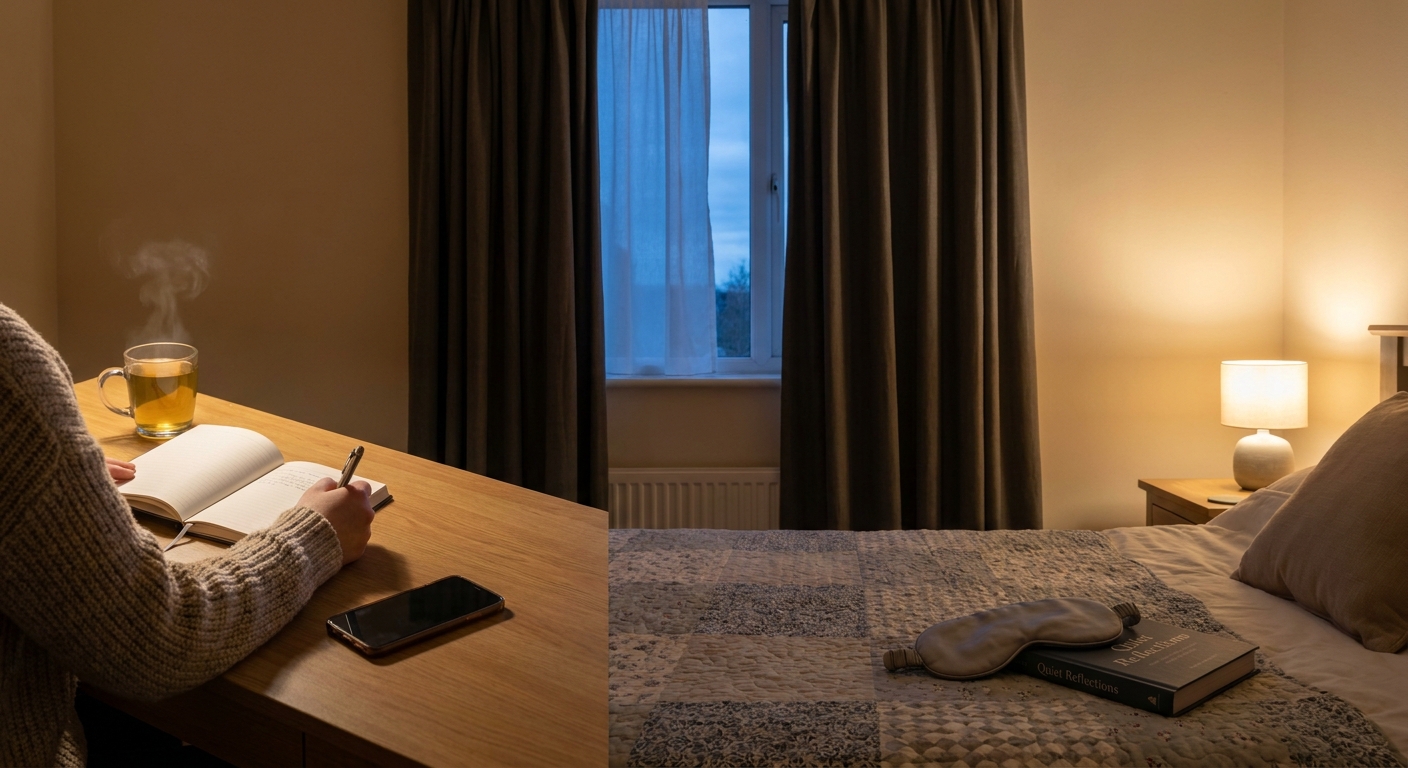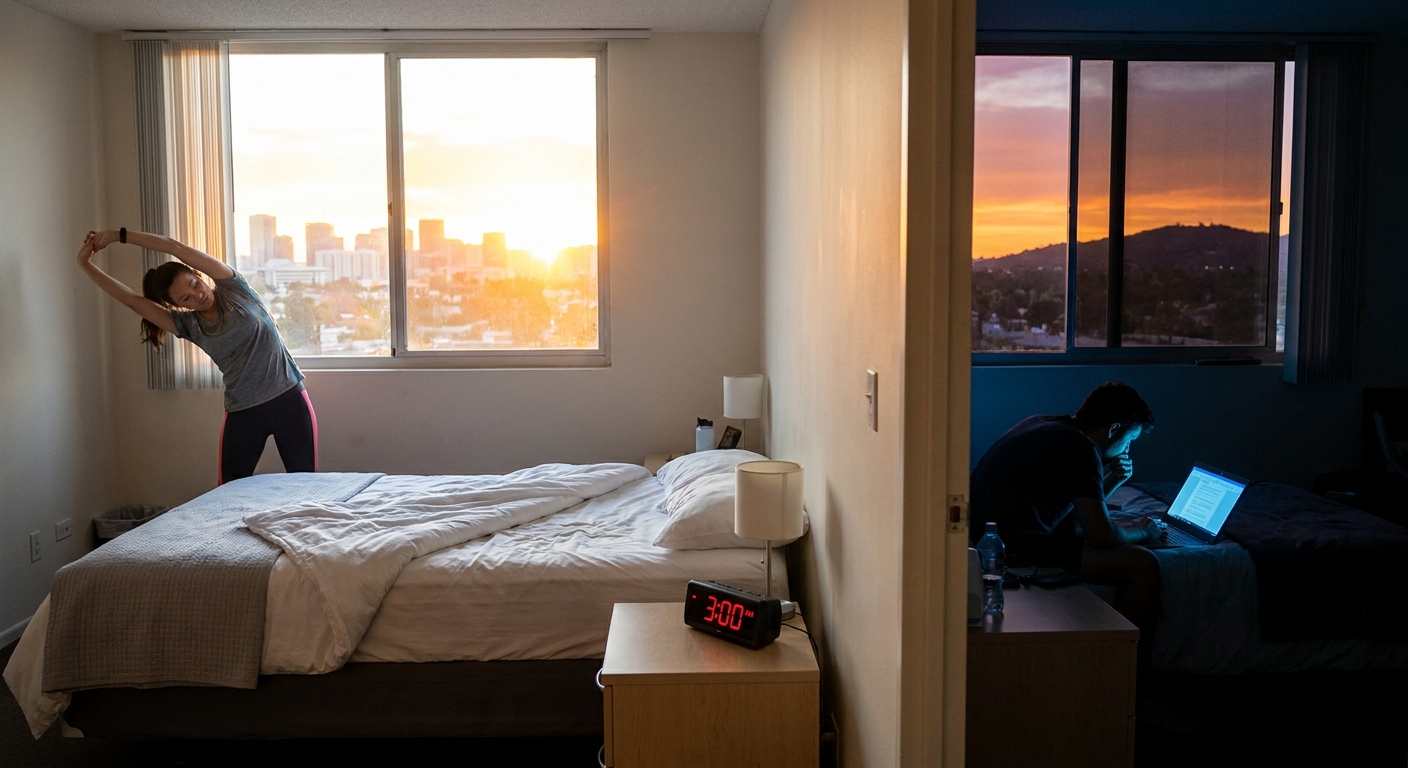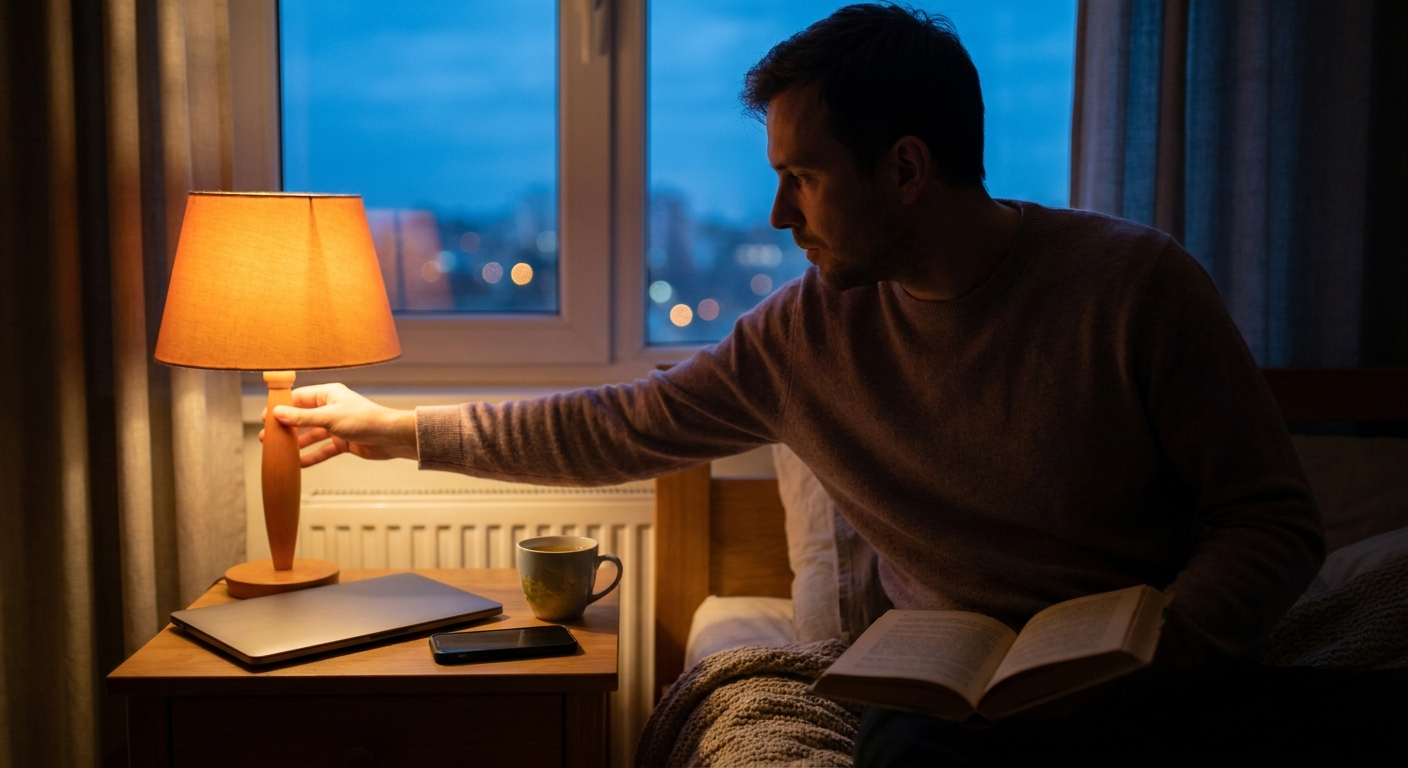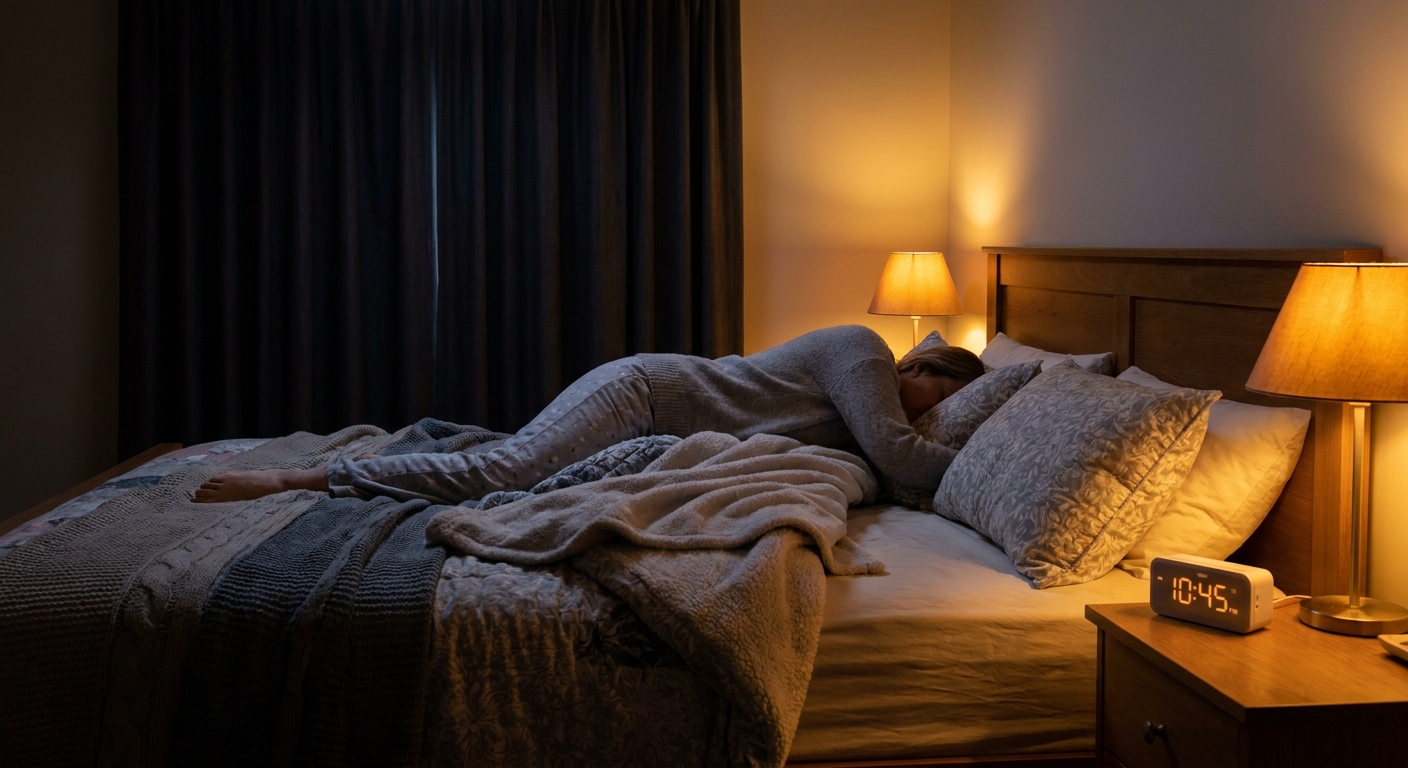
Your bedroom is more than four walls and a mattress. It is the container that holds your nights—your cocoon between days. Sleep hygiene starts here: in the shape of your pillow, the glow of your lamps, the hum or hush of your environment.
Your Bedroom as a Cocoon
Research consistently shows that the bedroom environment—light, noise, temperature, and comfort—meaningfully influences sleep quality and continuity.[^1][^2] By tuning this space with care, you invite your nervous system to loosen its grip, like fingers gently unclenching.
This article is a step-by-step blueprint to redesign your bedroom into a quiet ally for better sleep, with special tips for morning birds and night owls.
Step 1: Calibrate Temperature and Air
Find Your Cool, Not Cold
Sleep onset is tied to a drop in core body temperature.[^3] A slightly cool room supports this natural process.
Evidence-based range: Around 60–67°F (15–19°C) fits most adults.[^4]
Practical adjustments:
- Use a thermostat or fan to keep temperatures steady.
- Choose breathable layers rather than one heavy comforter, so you can adjust quickly at night.
- For hot climates, consider a cooling mattress pad or light, moisture-wicking sheets.
Let the Air Feel Clean
Poor air quality and stuffiness can worsen nasal congestion and impair sleep.[^5]
- Open windows when outdoor air is clean and weather allows.
- Use a HEPA filter if allergies or pollution are concerns.
- Wash bedding weekly in warm water to reduce dust mites and allergens.
- Evening types may benefit from a slightly cooler setting to counter late-night alertness.
- Morning types often get sleepy earlier; ensure the room isn’t so warm that it encourages dozing on the couch instead of transitioning to bed.
Chronotype note:
Step 2: Darken with Intent
Light tells your brain whether it is time to be awake or asleep. Even small amounts of light can suppress melatonin and shift your internal clock.[^6]
Layered Darkness
- Blackout curtains: Reduce streetlights, car beams, and early dawn.
- Eye masks: Helpful if you share a room or travel often.
- Device discipline: Turn phone screens face down; disable always-on displays.
Warm, Low-Level Night Lighting
If you need light at night (for children, bathroom visits, or safety):
- Use warm-colored night-lights (amber or red tones) at low intensity; these have less impact on circadian rhythms than blue or white light.[^7]
- Place lights below eye level, so the glow is indirect.
- Morning types: May benefit from very dark bedrooms if early dawn light wakes them too soon.
- Evening types: Should be especially cautious with evening screen use; blue-light-reducing filters and earlier device curfews can help.
Chronotype adaptations:
Step 3: Craft Your Soundscape
Noise doesn’t need to disappear; it only needs to become predictable and soft.
Quiet, or the Illusion of It
Sudden or irregular sounds—sirens, neighbors, door slams—cause micro-awakenings and fragment sleep architecture.[^8]
Options:
- White noise / Brown noise: Constant sound that masks unpredictable noises.
- Soft nature tracks: Rain, ocean waves, or rustling leaves can be calming, but keep the volume low.
- Earplugs: Useful if you share a bed or live in a loud area; foam or silicone models generally offer better isolation.
Tending to Household Noise
- Add rugs, soft curtains, and cushions to absorb sound.
- Close doors gently; consider soft-close hardware for drawers and cabinets.
- If your partner snores, encourage a medical evaluation; sleep apnea is common and treatable.[^9]
- Evening types often sleep later into noisier mornings; strong masking noise may help them sleep through early-day sounds.
- Morning types might be more sensitive to late-night household noise. Consider a shared household “quiet hour” to support them.
Chronotype angle:
Step 4: Curate Surfaces, Scents, and Visual Calm
Mattress and Pillow Fit
Comfort is subjective, but pain and pressure points disrupt sleep.[^10]
- Mattresses generally last 7–10 years; sagging or uneven support often signals it’s time for a replacement.
- Side sleepers usually prefer a softer surface; back and stomach sleepers often do better with medium to firm support.
- Choose pillows that keep your neck in neutral alignment with your spine.
Gentle Aromas (If You Enjoy Them)
Evidence for aromatherapy and sleep is mixed but promising for some scents, particularly lavender, in reducing anxiety and improving subjective sleep quality.[^11]
- Try a single drop of essential oil on a tissue placed away from direct contact with skin.
- Avoid overpowering scents; the goal is a whisper, not a shout.
Visual Simplicity
Your brain takes in the room even with lights dimmed. A cluttered space can subconsciously remind you of tasks and unfinished projects.
- Keep your immediate bedside area uncluttered: lamp, book, water, and perhaps one meaningful, calming object.
- Store laundry, work items, and exercise equipment out of sight if possible.
- Choose soft, neutral tones if you’re redecorating; calmer palettes may promote relaxation.[^12]
Step 5: Protect the Psychological Boundary of the Bed
The bed should be your body’s cue for sleep and intimacy—not for work, worry, or endless scrolling.
Repeatedly using the bed for wakeful activities trains the brain to associate it with alertness, not rest. Cognitive-behavioral therapy for insomnia (CBT-I) places heavy emphasis on this “stimulus control” principle.[^13]
Build Clear Associations
- Avoid working, studying, or eating in bed.
- If you’re awake and frustrated for ~20–30 minutes, get up and move to a dim, quiet room until drowsiness returns.
- Use your phone away from the bed during wind-down time; plug it in across the room or outside the bedroom.
- Evening types may be tempted to stay in bed scrolling if they can’t fall asleep early. Instead, move to a cozy chair with low light and a relaxing activity until your natural sleepiness arises.
- Morning types might wake early and lie in bed ruminating. Consider getting up to journal or read in low light until your target wake time.
Chronotype nuance:
Step 6: Tailoring for Different Sleepers Under One Roof
Many bedrooms are shared spaces: partners, roommates, children, and pets all influence your nights.
For Couples with Different Chronotypes
- Compromise on light: Use individual reading lamps with warm light and directional shades.
- Consider separate bedding: Different blankets or duvets can accommodate different temperature needs.
- Agree on a core quiet window: For example, 11 p.m.–6 a.m. as a time for soft voices and minimal movement.
If schedules are drastically misaligned, some couples choose a “sleep divorce” (separate beds or rooms) while maintaining emotional closeness. Studies suggest sleep quality itself supports relationship satisfaction.[^14]
For Parents and Caregivers
- Keep baby items organized and ready to minimize bright lights and noise during nighttime care.
- Use dim, warm night-lights rather than overhead lighting.
- Protect your own wind-down routine as much as possible, even if total sleep time is fragmented.
Pets in the Bedroom?
The evidence is mixed: some people find pets comforting, others find them disruptive.[^15]
- Notice how you actually sleep with versus without your pet, if you can experiment.
- If you keep pets in the room, train them to stay on a consistent spot (their own bed or blanket) to reduce sleep disruptions.
Step 7: A Gentle 7-Day Bedroom Reset Plan
You don’t need to overhaul everything at once. Try this sequence:
Day 1–2: Light
- Install blackout curtains or an eye mask.
- Set up warm, low-level lamps or night-lights.
- Adjust thermostat or fan; test small changes across nights.
- Open windows briefly during the day; launder bedding.
- Experiment with white or brown noise.
- Identify one noise source to soften (e.g., squeaky door, loud TV in another room).
- Clear the bedside area and one other surface.
- Fluff or replace pillows if needed.
- Decide one rule for the bed (e.g., “no laptops,” or “no social media scrolling in bed”).
Day 3–4: Temperature & Air
Day 5: Sound
Day 6: Surfaces & Clutter
Day 7: Boundaries
Take notes in a simple sleep diary—bedtime, wake time, perceived sleep quality—to track how adjustments affect your rest.
The Bedroom as a Quiet Ally
Your bedroom does not need to be perfect; it only needs to become more supportive than stressful. With each small change—dimming a light, softening a sound, clearing a surface—you’re sending a signal of safety to your nervous system.
Over time, your bedroom can feel less like a place where you battle with sleep and more like a cocoon: a consistent, gentle environment where your body remembers what it knew as a child—that night is a place to let go.
[^1]: Grander, M. A., & Fernandez-Mendoza, J. (2015). Sleep, insomnia, and health. Sleep Medicine Clinics, 10(1), 9–17.
[^2]: Cappuccio, F. P. et al. (2010). Sleep duration and all-cause mortality. Sleep, 33(5), 585–592.
[^3]: Krauchi, K., & Deboer, T. (2010). The interrelationship between sleep regulation and thermoregulation. Frontiers in Bioscience, 15, 604–625.
[^4]: Okamoto-Mizuno, K., & Mizuno, K. (2012). Effects of thermal environment on sleep and circadian rhythm. Journal of Physiological Anthropology, 31(1), 14.
[^5]: Koinis-Mitchell, D. et al. (2012). Environmental determinants of sleep in children. Sleep Medicine, 13(11), 1284–1290.
[^6]: Chang, A.-M. et al. (2015). Evening use of light-emitting eReaders negatively affects sleep. PNAS, 112(4), 1232–1237.
[^7]: Rahman, S. A. et al. (2011). Spectral modulation of melatonin suppression. Journal of Pineal Research, 50(4), 291–300.
[^8]: Basner, M., & McGuire, S. (2018). WHO environmental noise guidelines. IJERPH, 15(9), 1854.
[^9]: Peppard, P. E. et al. (2013). Increased prevalence of sleep-disordered breathing. American Journal of Epidemiology, 177(9), 1006–1014.
[^10]: Jacobson, B. H. et al. (2010). Changes in back pain, sleep quality, and perceived stress after introduction of new bedding systems. Applied Ergonomics, 42(2), 244–253.
[^11]: Lillehei, A. S. et al. (2015). Effect of lavender and sleep hygiene on sleep quality. Journal of Alternative and Complementary Medicine, 21(7), 430–438.
[^12]: Choi, J. et al. (2018). Color preference and sleep environment. Sleep Science, 11(4), 224–230.
[^13]: Edinger, J. D., & Means, M. K. (2005). Cognitive–behavioral therapy for primary insomnia. Clinical Psychology Review, 25(5), 539–558.
[^14]: Troxel, W. M. et al. (2007). Marital quality and the marital bed. Sleep Medicine Reviews, 11(5), 389–404.
[^15]: Smith, B. et al. (2014). Sleep with pets: An exploratory study. Mayo Clinic Proceedings, 89(12), 1670–1672.