Most of us treat bedtime like a cliff: one moment we’re answering emails, scrolling, or streaming; the next, we expect our brain to plunge into sleep on command. Biologically, though, sleep likes bridges, not cliffs.
Evenings as a Bridge, Not a Cliff
Your body needs time to shift from the alert, problem-solving mode of the day into the slower rhythms of night. A well-crafted evening routine—rooted in sleep hygiene and circadian science—builds that bridge gently.
Think of the next hour before bed as a sequence of soft dimmers: lights, thoughts, movement, and sound all turning down together.
The 60-Minute Wind-Down Framework
Research on behavioral treatments for insomnia consistently emphasizes regular pre-sleep routines, relaxation practices, and stimulus control (using the bed only for sleep and intimacy).[^1] You can blend these principles into a simple, repeatable rhythm.
We’ll walk through a 60-minute routine in four stages. Adjust the timing to your life and chronotype—owls may need to start later, larks earlier.
Stage 1 (60–45 Minutes Before Bed): Close the Day Gently
Shift Your Environment
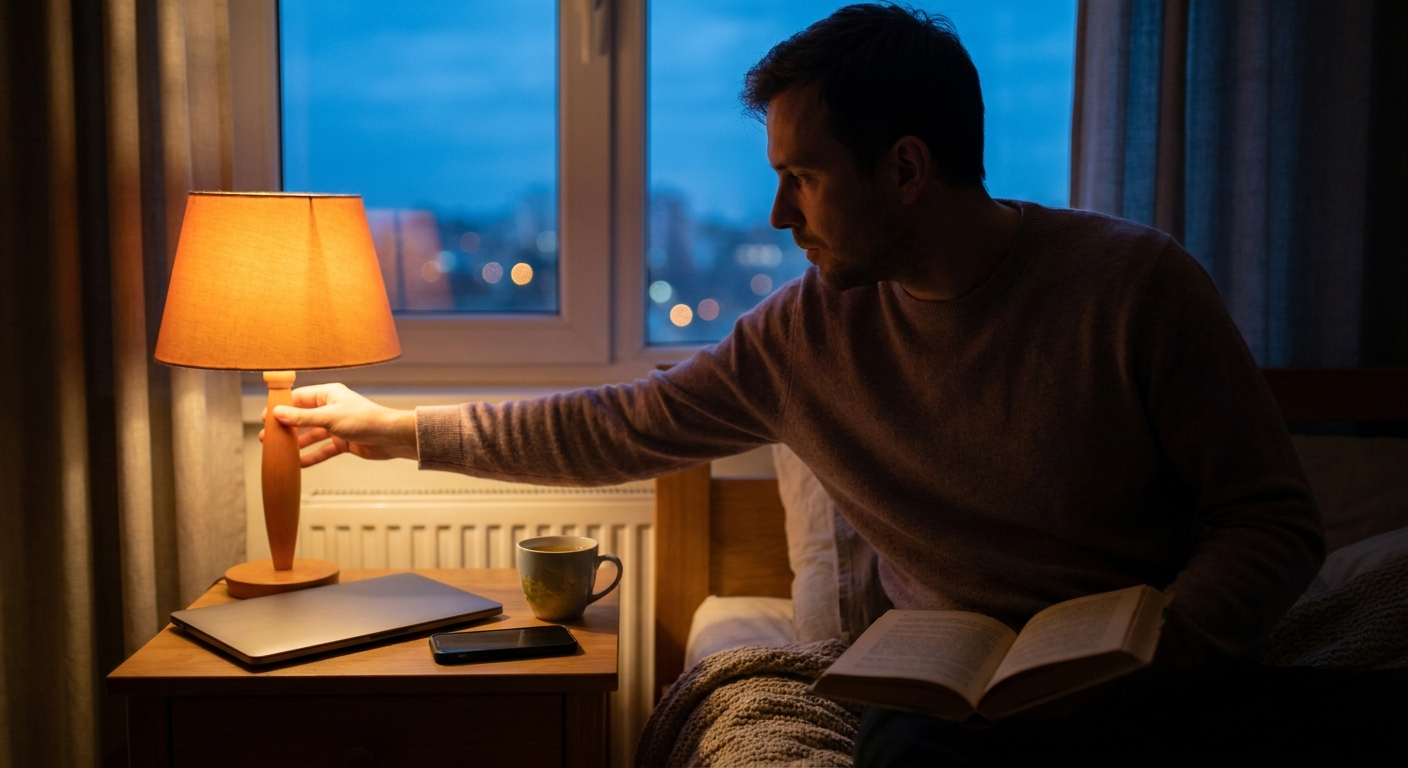
- Dim the lights: Lower overhead lights and switch to warm, low-level lamps. This gives your brain the clue that night is here, supporting melatonin release.[^2]
- Silence nonessential notifications: Put devices on “do not disturb” or use focus modes.
Create a Tomorrow Container
Rumination—replaying the day or worrying about tomorrow—is a powerful sleep thief.[^3]
Try a 5-minute ritual:
- Write down 3–5 tasks for tomorrow.
- Next to each, note a first tiny step (e.g., “Open the document,” “Send one email,” “Look up phone number”).
Studies show that structured worry and planning earlier in the evening can reduce bedtime rumination and shorten time to fall asleep.[^4]
Chronotype note:
- Evening types: Do this earlier in the night, before your mental creativity peaks, so your wind-down period stays light.
- Morning types: Keep the list brief to avoid reactivating your planning brain.
Stage 2 (45–30 Minutes Before Bed): Soothe the Body
Light Movement, Not Workout
Intense exercise close to bedtime can raise body temperature and delay sleep in some people.[^5] But gentle movement can release muscle tension.
Options (5–10 minutes):
- Slow stretching focusing on neck, shoulders, and hips.
- Restorative yoga poses (child’s pose, legs-up-the-wall).
- A short, unhurried walk down the hallway or around your home.
Warm Water, Cool Body
A warm bath or shower 60–90 minutes before bed helps your body shed heat afterward, supporting sleep onset.[^6]
If your schedule doesn’t allow that window, even a brief warm rinse during this stage can be part of a calming ritual.
Bedroom Check-In
Use this time to prepare your sleep environment:
- Set the room temperature to a cool, comfortable range (60–67°F / 15–19°C).[^7]
- Turn down the bed, fluff pillows, and clear clutter from your bedside table.
- Adjust light levels so that when you return later, your room already looks like “sleep.”
Stage 3 (30–10 Minutes Before Bed): Quiet the Mind
Now you’re crossing the bridge from doing to being.
Choose One Calming Anchor Activity
Pick an activity you’ll associate with winding down:
- Paper reading: Fiction or gentle non-fiction under warm, dim light. Avoid intense thrillers if they leave you wired.
- Guided relaxation: A short audio body scan, progressive muscle relaxation, or breathing practice. These techniques reduce physiological arousal and have strong evidence in insomnia treatment.[^8]
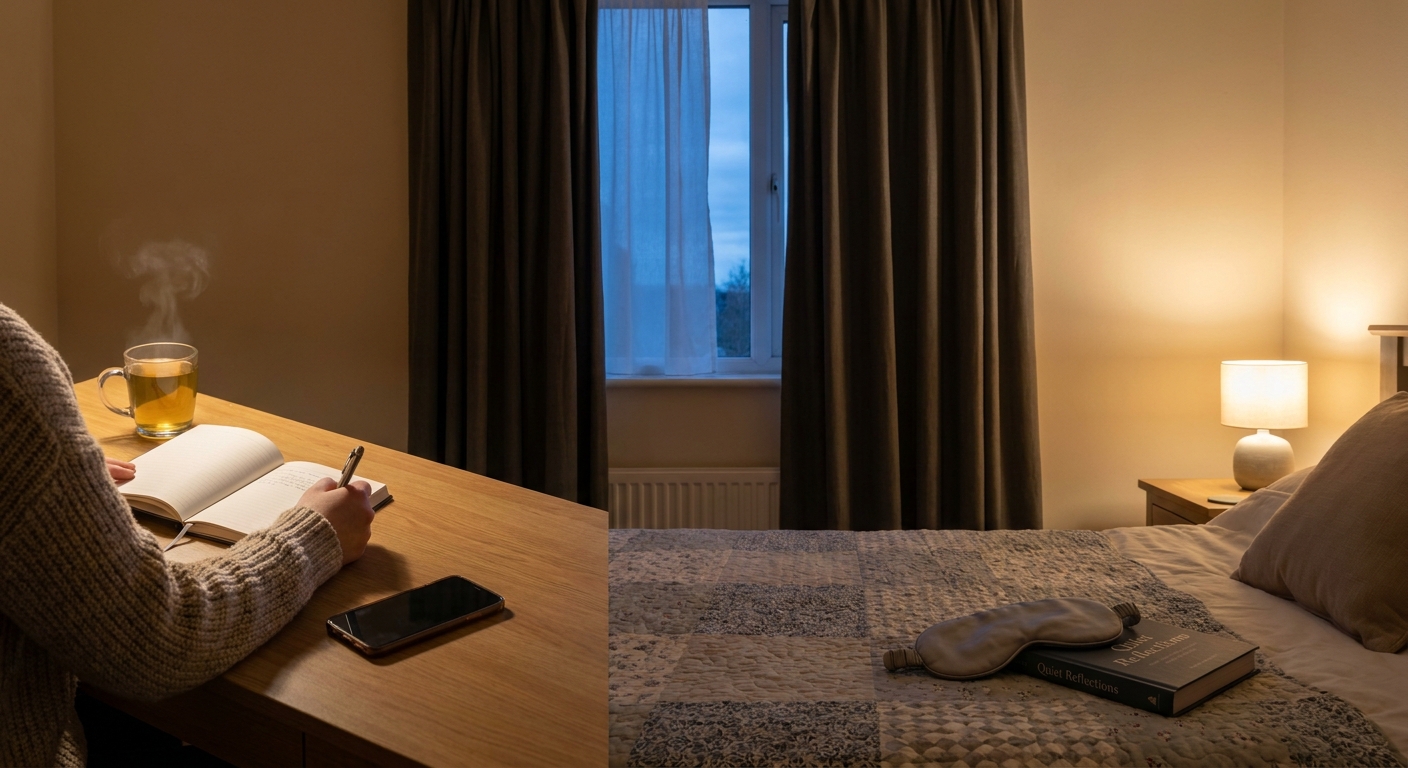
- Restorative journaling: Not a to-do list, but reflection—three things that went well, or a brief gratitude list. Positive reflection practices are linked to better sleep quality.[^9]
Keep screens out of this stage if possible. If you must use a device, lower brightness, use a blue-light filter, and avoid emotionally charged content.
Gentle Breathing Pattern
A simple pattern like 4-6 breathing (inhale for 4 seconds, exhale for 6) can stimulate the parasympathetic nervous system, which calms heart rate and promotes relaxation.[^10]
Try for 3–5 minutes:
- Inhale through your nose for 4 counts.
- Exhale slowly through your mouth for 6 counts.
- Allow your belly to rise and fall.
Chronotype nuance:
- Owls: This stage is crucial; your mind may be lively. Choose an anchor that’s soothing but not highly absorbing (e.g., gentle audio instead of engaging games).
- Larks: You may feel sleepy already. Keep this stage short and free of bright light.
Stage 4 (Last 10 Minutes): Signal “Bed = Sleep”
Enter the Bedroom as a Cue
When you step into your bedroom, your environment should quietly say: nothing more is required of you today.
- Lights are low or off.
- Temperature is set.
- Devices are charging away from the bed if possible.
In Bed: One Simple Practice
Get into bed only when you feel genuinely drowsy (eyes heavy, thoughts slowing). In bed, you might:
- Do a very brief body scan: Starting at your toes, gently notice and relax each part of your body up to your head.
- Repeat a soft phrase on each exhale, like “letting go” or “I am safe to rest.”
If you find yourself awake and frustrated for more than ~20–30 minutes, practice stimulus control: get up, go to a dim room, and return to a quiet activity from Stage 3 until sleepiness returns.[^11]
This teaches your brain that bed is for sleep, not worry.
Adapting the Routine to Your Life
For Parents and Caregivers
- Break the routine into micro-rituals: a 5-minute worry list, a 3-minute stretch, a 5-minute breathing practice in bed.
- Align children’s wind-down with yours: dim lights and lower noise for the whole household.
For Shift Workers
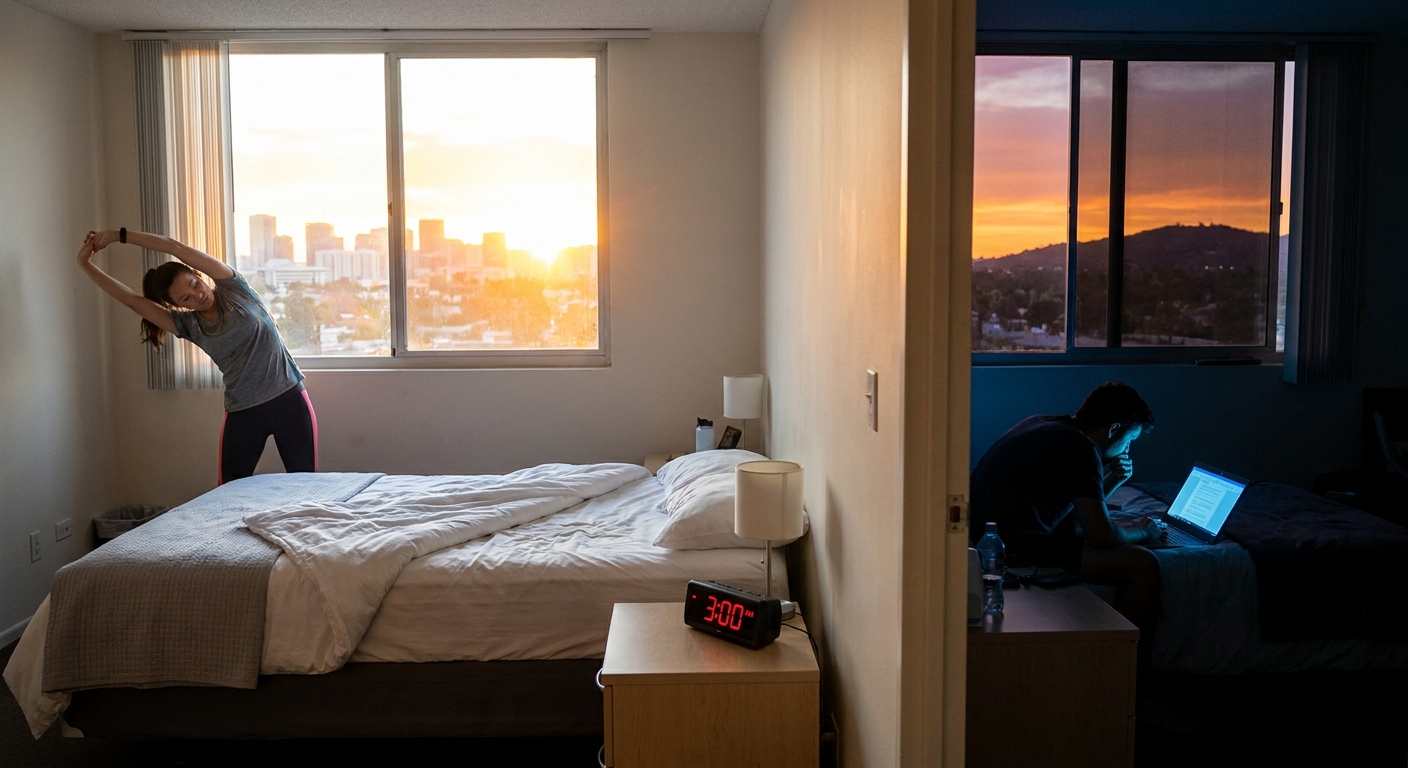
- Move the entire sequence to your "biological evening" (the last hour before your main sleep period), even if that’s morning or afternoon.
- Use blackout curtains and white noise to simulate night.
For Anxiety or Insomnia
- Keep your pre-sleep routine predictable; repetition itself becomes calming.
- Avoid using wind-down time to solve big problems; schedule a separate, earlier “worry time” instead.
- If difficulties persist for more than a few months, consider cognitive-behavioral therapy for insomnia (CBT-I), the gold-standard non-drug treatment.[^12]
Supporting Your Evening Routine All Day Long
Your evening doesn’t exist in isolation. Small daytime practices make your wind-down smoother:
- Morning light exposure helps anchor your circadian rhythm and sets the stage for easier sleep at night.[^13]
- Regular exercise, especially earlier in the day, is linked to better sleep quality.[^14]
- Caffeine timing: Try to keep caffeine to the first 6–8 hours after waking.[^15]
- Meal timing: Avoid very heavy meals close to bedtime; opt for lighter, earlier dinners when possible.
A Gentle 7-Day Experiment
You don’t need to adopt a perfect routine overnight. Try a simple experiment:
Days 1–2:
- Pick a consistent wind-down start time, roughly 60 minutes before your ideal bedtime.
- Dim lights and do a 5-minute “tomorrow list.”
- Add a 5–10 minute stretching or gentle movement block.
- Adjust bedroom temperature and clutter.
- Add a single calming anchor (reading, breathing, or guided relaxation).
- Practice stimulus control: if you’re awake and tense in bed after ~20–30 minutes, get up briefly and return only when drowsy.
Days 3–4:
Days 5–6:
Day 7:
Note your sleep times, how long it takes to fall asleep, and how rested you feel. Look for trends, not perfection.
Letting the Day Settle
An evening routine is not a performance to perfect. It’s closer to setting a table for a guest you trust: sleep.
By dimming your environment, softening your thoughts, and moving your body toward stillness, you’re simply making the invitation clearer. Your brain already knows how to sleep. You’re just clearing a path so it can find the way more easily.
Your evenings can become less like a cliff and more like a gentle shoreline, where the waves of the day recede slowly, and you’re carried into rest almost without noticing.
[^1]: Irish, L. A. et al. (2015). The role of sleep hygiene in promoting public health. Sleep Medicine Reviews, 22, 23–36.
[^2]: Chang, A.-M. et al. (2015). Evening use of light-emitting eReaders negatively affects sleep. PNAS, 112(4), 1232–1237.
[^3]: Harvey, A. G. (2002). A cognitive model of insomnia. Behaviour Research and Therapy, 40(8), 869–893.
[^4]: Scullin, M. K. et al. (2018). The effects of bedtime writing on difficulty falling asleep. Journal of Experimental Psychology: General, 147(2), 257–269.
[^5]: Stutz, J. et al. (2019). Effects of evening exercise on sleep. Sports Medicine, 49(2), 269–287.
[^6]: Haghayegh, S. et al. (2019). The effects of a warm shower or bath before bedtime. Sleep Medicine Reviews, 46, 124–135.
[^7]: Okamoto-Mizuno, K., & Mizuno, K. (2012). Effects of thermal environment on sleep and circadian rhythm. Journal of Physiological Anthropology, 31(1), 14.
[^8]: Edinger, J. D., & Means, M. K. (2005). Cognitive–behavioral therapy for primary insomnia. Clinical Psychology Review, 25(5), 539–558.
[^9]: Jackowska, M. et al. (2016). Gratitude and sleep: Daily assessments. Health Psychology, 35(1), 34–41.
[^10]: Zaccaro, A. et al. (2018). How breath-control can change your life. Frontiers in Human Neuroscience, 12, 353.
[^11]: Bootzin, R. R., & Perlis, M. L. (1992). Stimulus control therapy for insomnia. In Case Studies in Insomnia.
[^12]: Trauer, J. M. et al. (2015). Cognitive behavioral therapy for chronic insomnia. Annals of Internal Medicine, 163(3), 191–204.
[^13]: Khalsa, S. B. S. et al. (2003). A phase response curve to single bright light pulses. Journal of Physiology, 549(3), 945–952.
[^14]: Kredlow, M. A. et al. (2015). The effects of physical activity on sleep. Journal of Behavioral Medicine, 38(3), 427–449.
[^15]: Drake, C. et al. (2013). Caffeine effects on sleep taken 0, 3, or 6 hours before bedtime. J Clin Sleep Med, 9(11), 1195–1200.