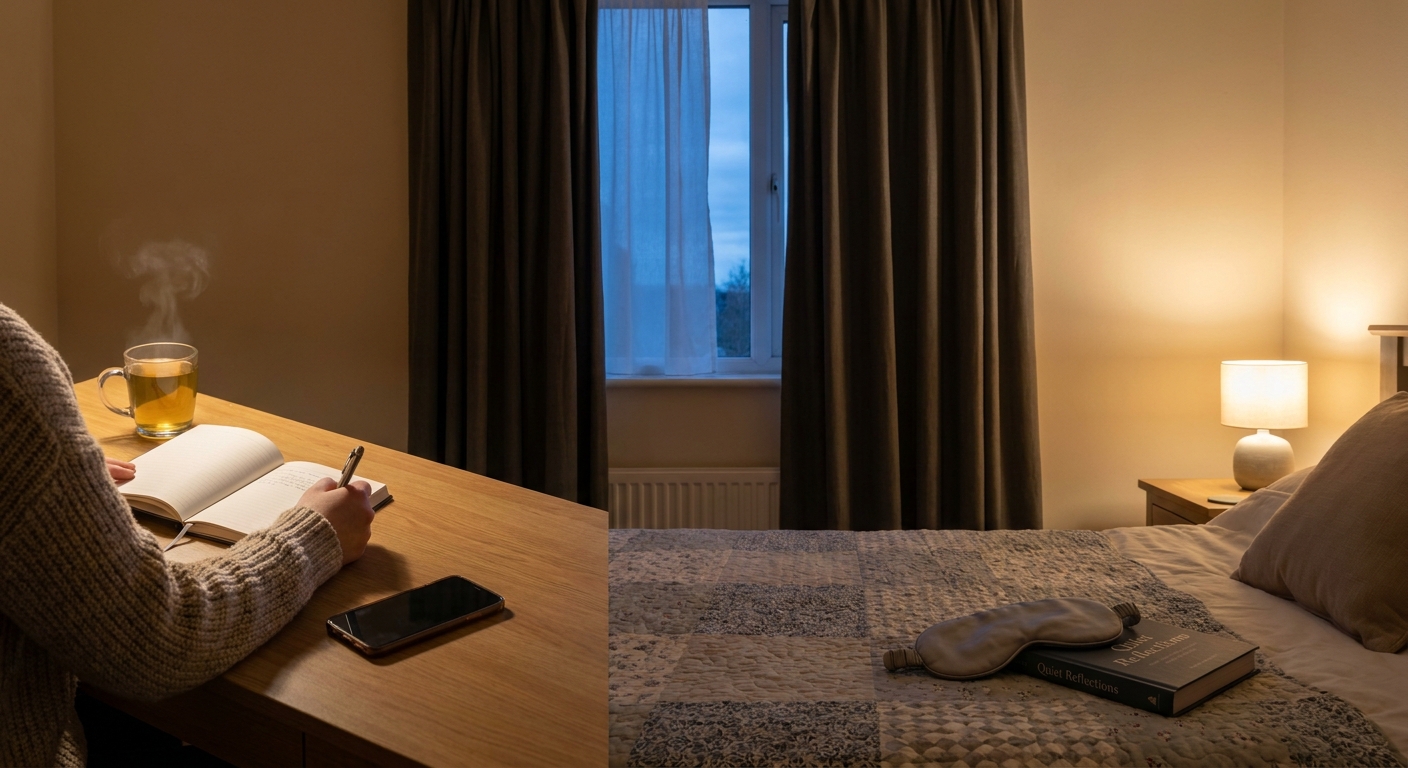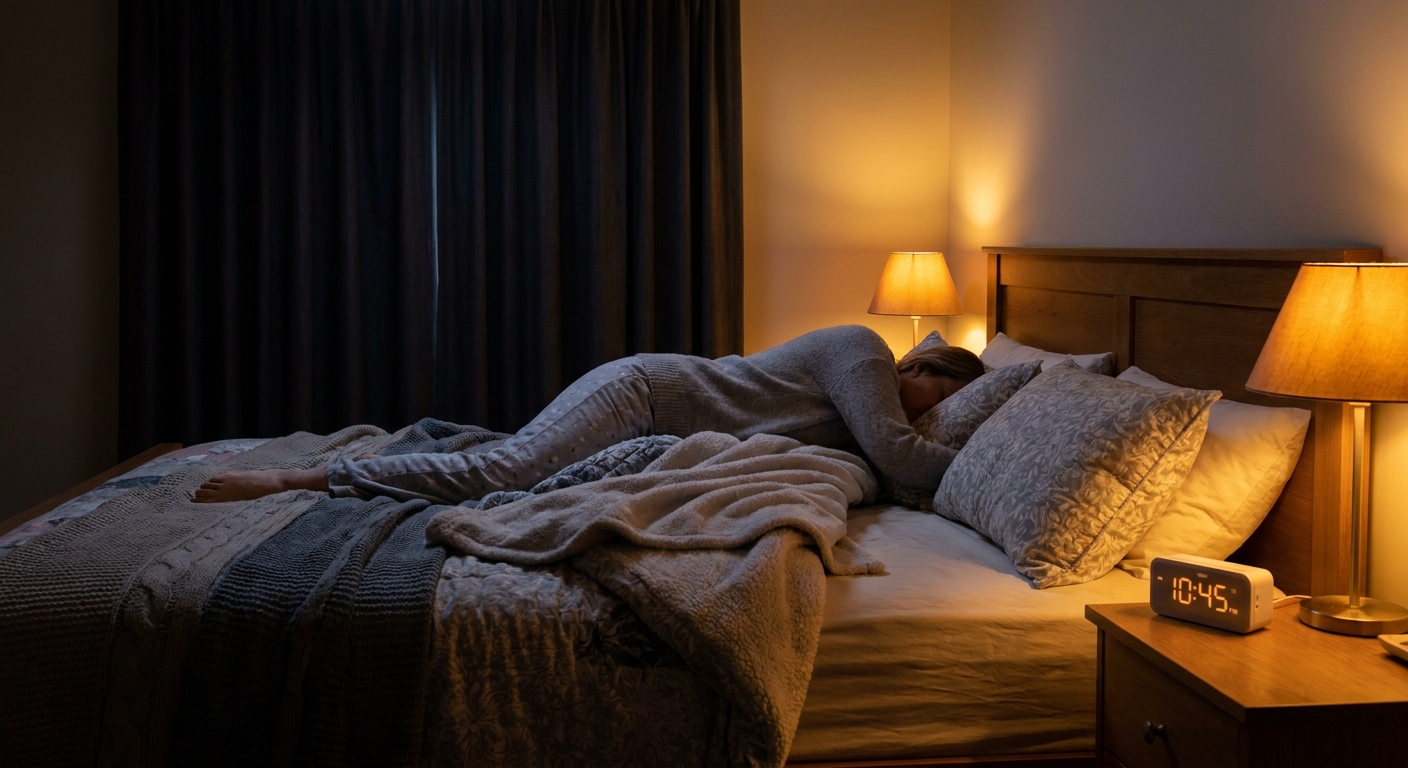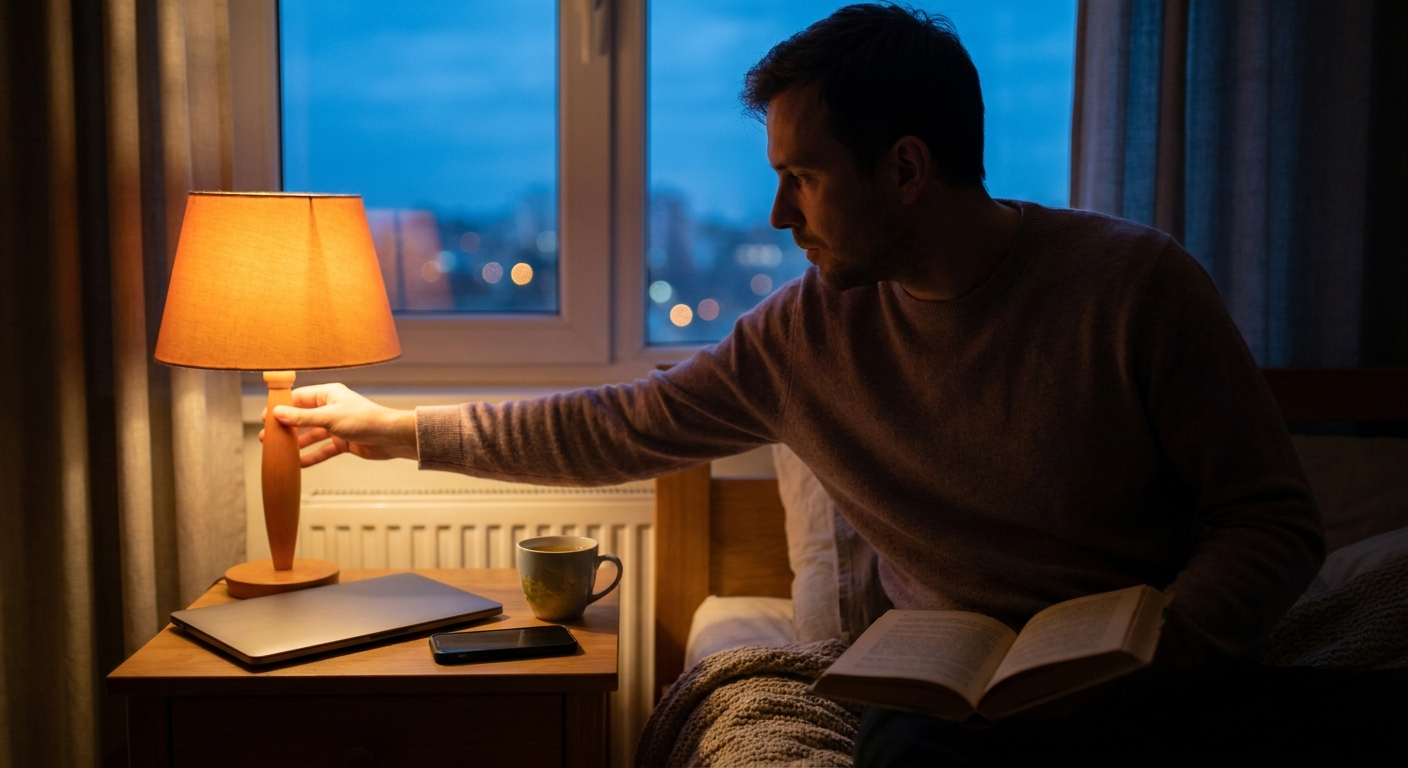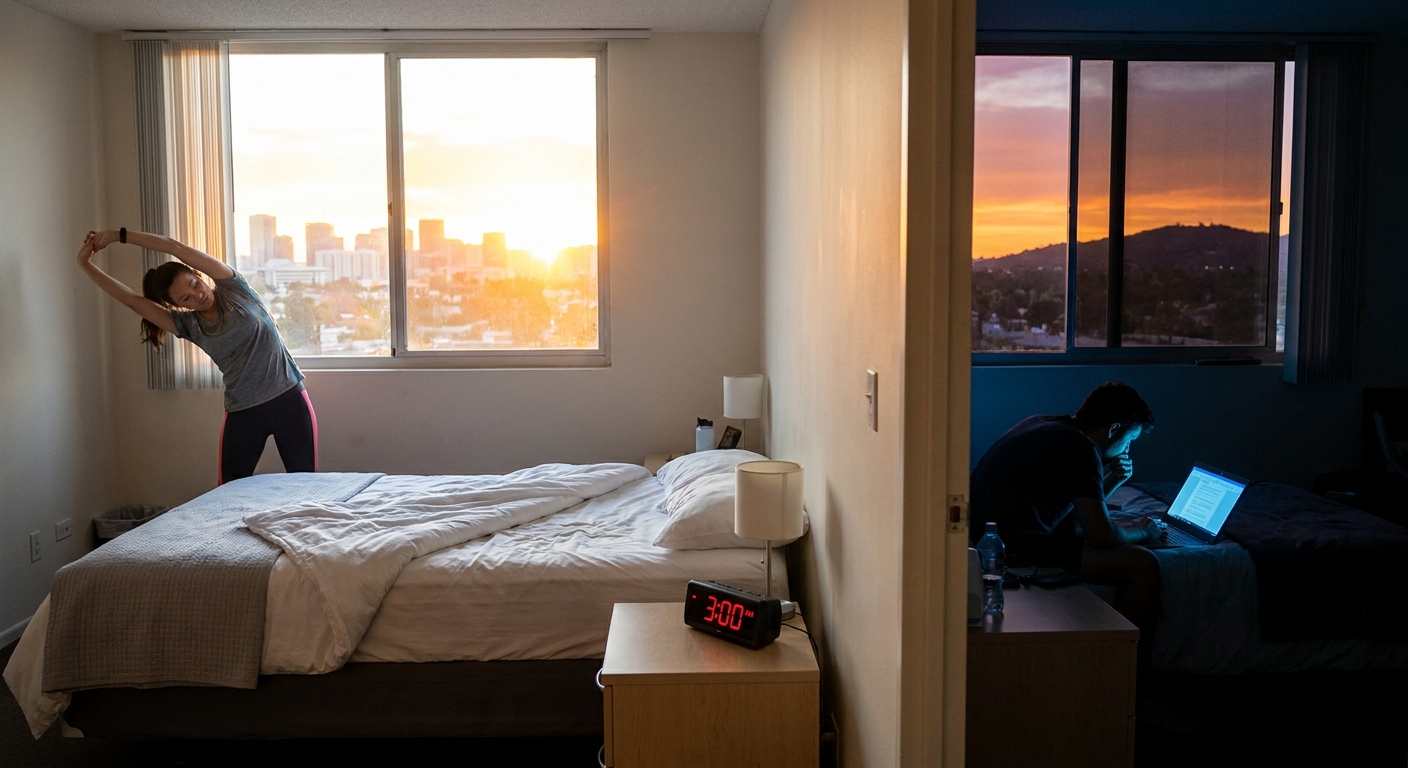
Some people bloom with the sunrise; others come alive under city lights. These patterns are not flaws or virtues—they are chronotypes, your internal timing preferences shaped by genetics, age, and environment.[^1]
Your Inner Clock, Not Your Character
Sleep hygiene often sounds like one-size-fits-all advice: go to bed early, wake up early, avoid screens. But your biological clock may keep different hours. When sleep guidelines ignore chronotypes, they can feel like shoes that simply don’t fit.
This guide explores how to practice evidence-based sleep hygiene for your specific chronotype, with practical tweaks to your days, nights, and bedroom.
What Is a Chronotype?
Chronotype describes where you naturally fall on the spectrum from morningness to eveningness:
- Morning types (“larks”): Naturally wake early, feel most alert in the morning, and get sleepy early.
- Evening types (“owls”): Prefer later bedtimes and wake times; peak alertness often in late afternoon/evening.
- Intermediate types: Most people—somewhere in the middle.
These preferences are partly genetic[^2] and shift across the lifespan: children are often earlier types, teenagers trend late, and older adults shift earlier again.[^3]
You can roughly identify your chronotype by noticing:
- When you wake up and fall asleep on free days (no alarm).
- When focus feels natural vs. forced.
- Whether early mornings or late nights feel more like your true self.
Core Sleep Hygiene Habits (For Everyone)
Before we split by chronotype, some fundamentals apply across the board:[^4]
- Consistent wake time: Aim to wake within the same 60-minute window every day.
- Wind-down routine: A 30–60 minute period of dim light, low stimulation, and calming activities.
- Sleep-friendly bedroom: Cool (60–67°F / 15–19°C), dark, quiet, and comfortable.[^5]
- Caffeine awareness: Avoid caffeine within at least 6 hours of bedtime.[^6]
- Alcohol caution: Avoid heavy drinking, especially within 3 hours of sleep; it fragments sleep and suppresses REM.[^7]
Now, let’s tailor these basics to your inner clock.
Sleep Hygiene for Morning Types (Larks)
Morning types are often praised for aligning with conventional schedules, but they face their own challenges: evening social plans, late work shifts, and the risk of excessively early waking.
Daytime Strategies
- Anchor your wake time: Choose a wake time that fits your obligations and doesn’t make bedtime unreasonably early. For example, if you wake naturally at 5:30 a.m. but don’t need to, experiment with 6:00–6:30 a.m.
- Time your light: Get abundant morning light to keep your clock stable, but consider limiting very early light (before 5 a.m.), which may further advance your schedule.[^8]
- Schedule demanding tasks early: Place complex or creative tasks in the first half of the day when your alertness peaks.
Evening Hygiene for Larks
Morning types often feel very sleepy early—and may then wake too early.
- Set a “no-nap after” time: If you nap, keep it before 2 p.m. to avoid pulling bedtime too early.
- Use gentle, warm light in the evening: Avoid total darkness hours before bed; a little non-blue, warm light can keep your bedtime from creeping earlier.
- Plan soothing social time earlier: Shift dinners, calls, or hobbies to the early evening.
Bedroom Tips for Larks
- Block early morning light with blackout curtains or a sleep mask.
- If noise (garbage trucks, birds, early risers) wakes you, use white noise to smooth the morning soundscape.
- Keep a notepad on the nightstand; if you wake early with a busy mind, jot down thoughts and gently attempt another sleep cycle.
Sleep Hygiene for Evening Types (Owls)
Evening types are common—especially among adolescents and young adults—but modern society often expects them to function as morning types. This mismatch, sometimes called social jet lag, is linked to poorer mood, metabolic health, and performance.[^9]
Strategic Light and Timing
Light is your most powerful tool for shifting an evening chronotype earlier.[^10]
- Morning light therapy: Get 20–45 minutes of outdoor light within an hour of waking. In dark months, consider a 10,000 lux light box (placed to the side, not directly in front, after medical guidance).
- Evening light discipline: Dim lights 1–2 hours before target bedtime. Use warm-colored lamps and minimize overhead lighting.
- Screen curfew: Ideally stop bright screens 60 minutes before bed, or at least use blue-light filters and lower brightness.
Gradual Schedule Shifts
Don’t try to leap from a 1 a.m. bedtime to 10 p.m. overnight.
- Move bedtime and wake time earlier by 15–20 minutes every few days.
- Anchor changes with consistent meal times and exercise earlier in the day.
- Even if sleep feels short at first, keep wake time fixed; your body will gradually adjust.
Evening Wind-Down for Owls
Evening types often feel mentally alive at night. The goal is not to shut this off abruptly but to redirect it gently.
- Reserve the last hour for low-stakes creativity: journaling, sketching, gentle music, or reading fiction.
- Avoid intense gaming, problem-solving, or emotionally charged conversations late at night.
- Use relaxation techniques (breathing, body scans, progressive muscle relaxation) to ease the transition from mental energy to restful awareness.[^11]
Bedroom Tips for Owls
- Keep the room especially dark and cool; evening types may be more prone to late-night alertness.
- Use your bed only when truly sleepy; if you’re lying awake, move to a cozy chair with dim light until drowsiness arises.
Sleep Hygiene for Intermediate Types
If you’re neither a clear lark nor owl, you have flexibility—but that flexibility can lead to irregular schedules.
Protect Regularity
- Aim for a stable sleep window (e.g., 11 p.m.–7 a.m.) that feels realistic most days.
- Limit weekend drift; try not to let bed and wake times move more than an hour.
- Keep daily anchors: consistent wake time, regular meals, similar exercise times.
Align with Your Natural Peak
- Identify your mental “sweet spot” (often late morning or early afternoon) and place important tasks there.
- Use light strategically: more bright light in your peak hours, dimmer light in your pre-sleep period.
Bedroom and Routine
Intermediate types benefit from classic sleep hygiene:
- 30–60 minute wind-down with dim light and calming rituals.
- A cool, dark, quiet room with minimal clutter.
- Avoid keeping work materials in the bedroom to reduce the temptation to “just finish a few emails.”
Shared Household, Different Clocks
Many homes contain a mix of chronotypes. Instead of fighting biology, consider zoning and compromise:
- Use earbuds or headphones for late-night or early-morning media.
- Agree on a core quiet window (for example, midnight to 6 a.m.) where noise and lights are kept low.
- Adjust bedroom design: separate blankets, dimmable lamps, and white noise can allow different sleep and wake times in the same space.
When Your Schedule Can’t Match Your Chronotype
Shift work, parenting, and caregiving often override internal preferences. In these cases, aim for damage reduction:
- Keep at least one anchor stable: either wake time or bedtime, depending on what your obligations allow.
- Use strategic naps (20–30 minutes, earlier in your wake period) to manage sleep debt without disrupting nighttime sleep.[^12]
- Support recovery with strong sleep hygiene on free days: dark, cool bedroom; strict light control; and deliberate wind-down.
Gentle Self-Compassion for Every Type
It’s easy to criticize yourself: “I’m lazy,” “I’m broken,” “I should be able to sleep on command.” But chronic sleep difficulties are rarely about effort or character. Often, they are about biology plus environment.
Wherever you fall on the chronotype spectrum, your body is working to protect you—staying alert when it senses light, stimulation, or irregular cues.
Sleep hygiene is about reassuring your nervous system: dimming lights, quieting noise, smoothing routines, and aligning your days a little more closely with your natural rhythm.
You do not need to transform overnight. Choose one or two changes suited to your chronotype—a slightly earlier wake time, a darker bedroom, a gentler wind-down—and let them take root.
In time, your nights can feel less like a negotiation and more like a tide you’ve learned to work with: reliable, rhythmic, and deeply your own.
[^1]: Roenneberg, T. et al. (2007). Epidemiology of the human circadian clock. Current Biology, 17(22), R1038–R1043.
[^2]: Jones, S. E. et al. (2019). Genome-wide association analyses of chronotype. Nature Communications, 10, 343.
[^3]: Crowley, S. J. et al. (2007). A longitudinal assessment of sleep timing in adolescents. Sleep, 30(12), 1675–1684.
[^4]: Irish, L. A. et al. (2015). The role of sleep hygiene in promoting public health. Sleep Medicine Reviews, 22, 23–36.
[^5]: Okamoto-Mizuno, K., & Mizuno, K. (2012). Effects of thermal environment on sleep and circadian rhythm. Journal of Physiological Anthropology, 31(1), 14.
[^6]: Drake, C. et al. (2013). Caffeine effects on sleep taken 0, 3, or 6 hours before bedtime. J Clin Sleep Med, 9(11), 1195–1200.
[^7]: Ebrahim, I. O. et al. (2013). Alcohol and sleep I: Effects on normal sleep. ACER, 37(4), 539–549.
[^8]: Khalsa, S. B. S. et al. (2003). A phase response curve to single bright light pulses. Journal of Physiology, 549(3), 945–952.
[^9]: Wittmann, M. et al. (2006). Social jetlag: Misalignment of biological and social time. Chronobiology International, 23(1–2), 497–509.
[^10]: Duffy, J. F., & Czeisler, C. A. (2009). Effect of light on human circadian physiology. Sleep Medicine Clinics, 4(2), 165–177.
[^11]: Edinger, J. D., & Means, M. K. (2005). Cognitive–behavioral therapy for primary insomnia. Clinical Psychology Review, 25(5), 539–558.
[^12]: Faraut, B. et al. (2015). Napping: A public health issue. Sleep Medicine Reviews, 22, 23–30.