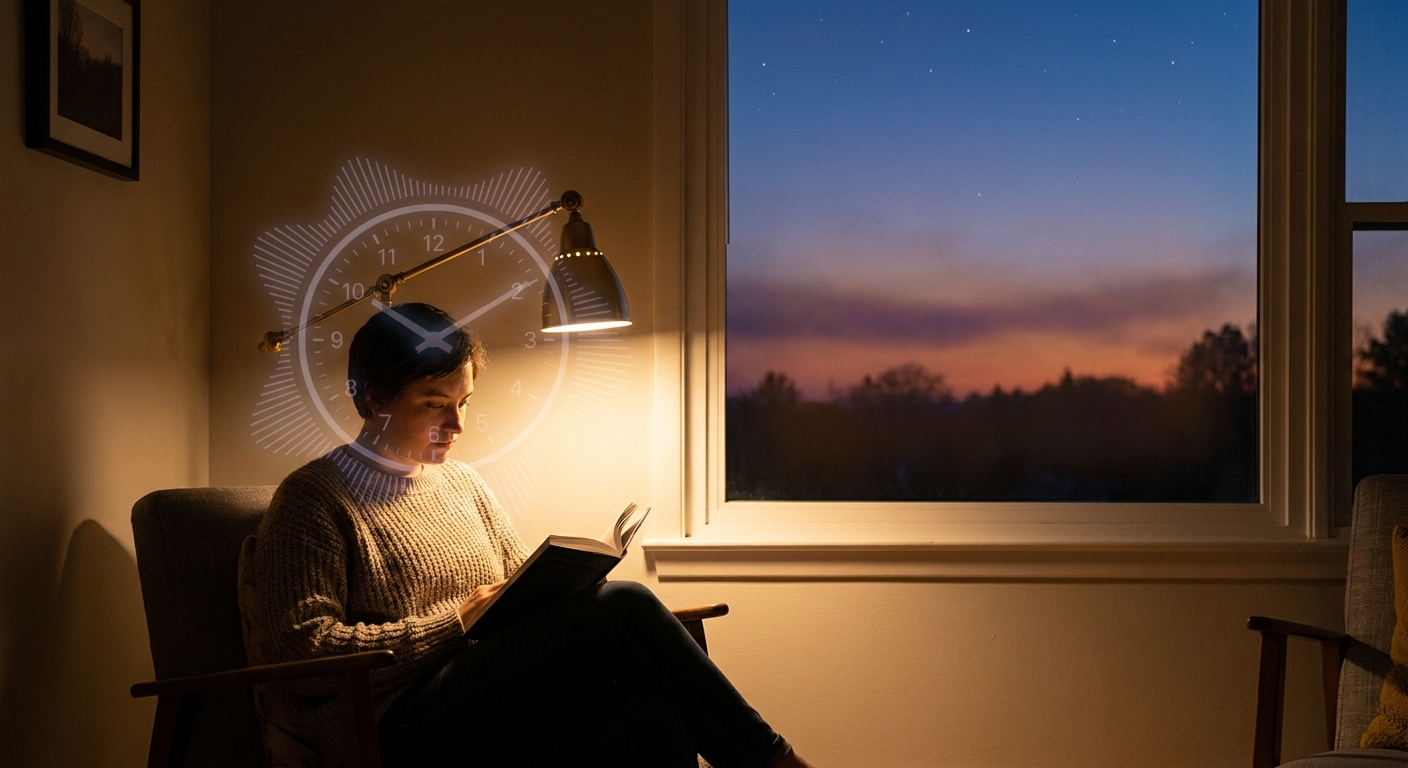
Sleep does not begin at bedtime; it’s the final movement in a day-long choreography between light and darkness, activity and rest. The habits you weave through your daylight hours and the rituals you keep at night form a duet that either harmonizes with your circadian rhythm—or tangles it.
Two Partners in One Dance: Your Days and Your Nights
This article gently compares daytime and night-time choices through the lens of circadian science, showing how each side of the 24-hour cycle shapes your ability to drift into deep, restorative sleep. Along the way, you’ll find practical bedroom changes and chronotype-specific tips, anchored in current research.
The Circadian Stage: How Your Internal Clock Sets the Scene
At the heart of this dance is your suprachiasmatic nucleus (SCN), the brain’s master clock. It orchestrates daily rhythms in hormone release, body temperature, alertness, and sleepiness.[^1]
Key players in this performance include:
- Cortisol – Generally higher in the morning, supporting wakefulness.
- Melatonin – Rises in the evening under dim light, signaling night.
- Body temperature – Typically lowest in the early morning, highest late afternoon.[^2]
How you treat your days and nights influences when these actors step onto the stage.
Day vs. Night: Light Exposure
Daytime Light: The Wakeful Spotlight
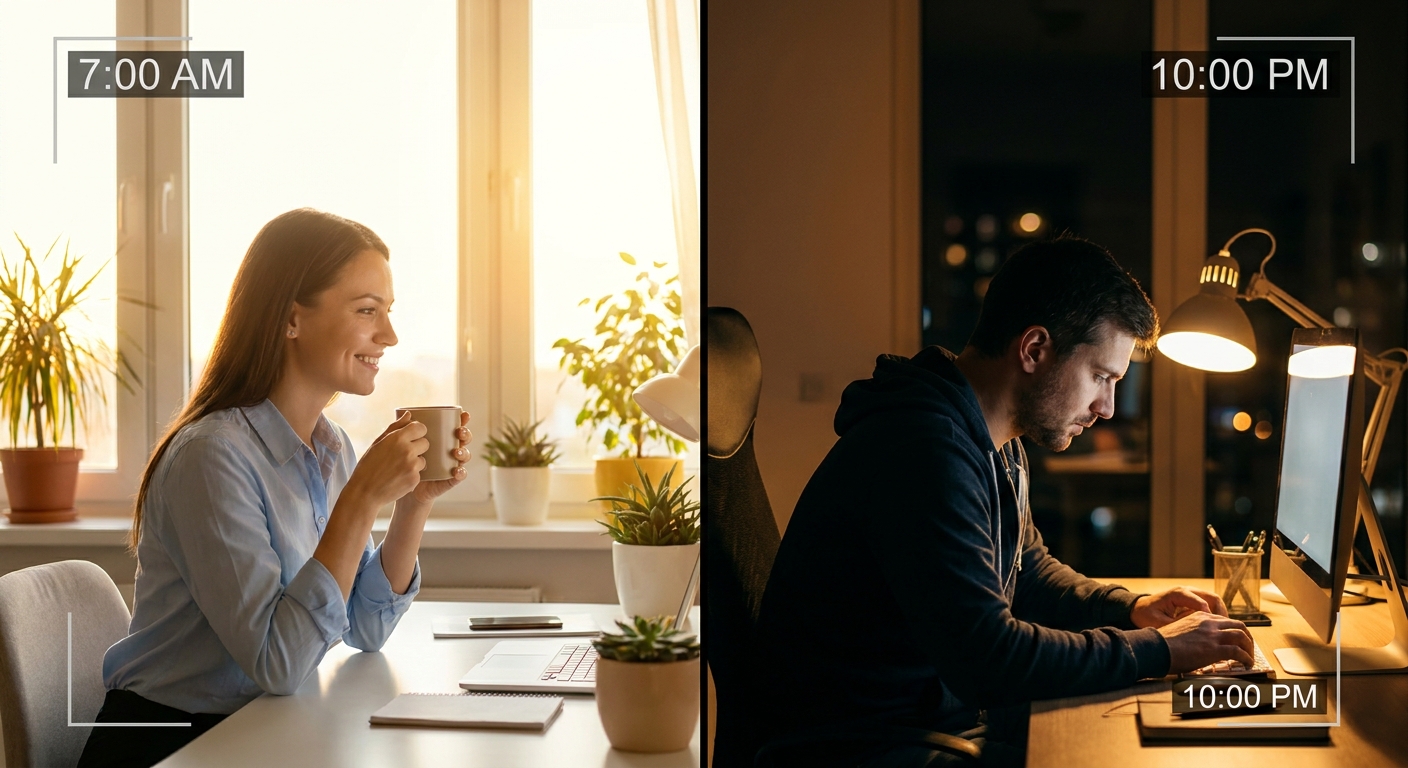
Bright light in the morning and daytime is one of the strongest anchors for your circadian clock.[^3]
Daytime habits that help:
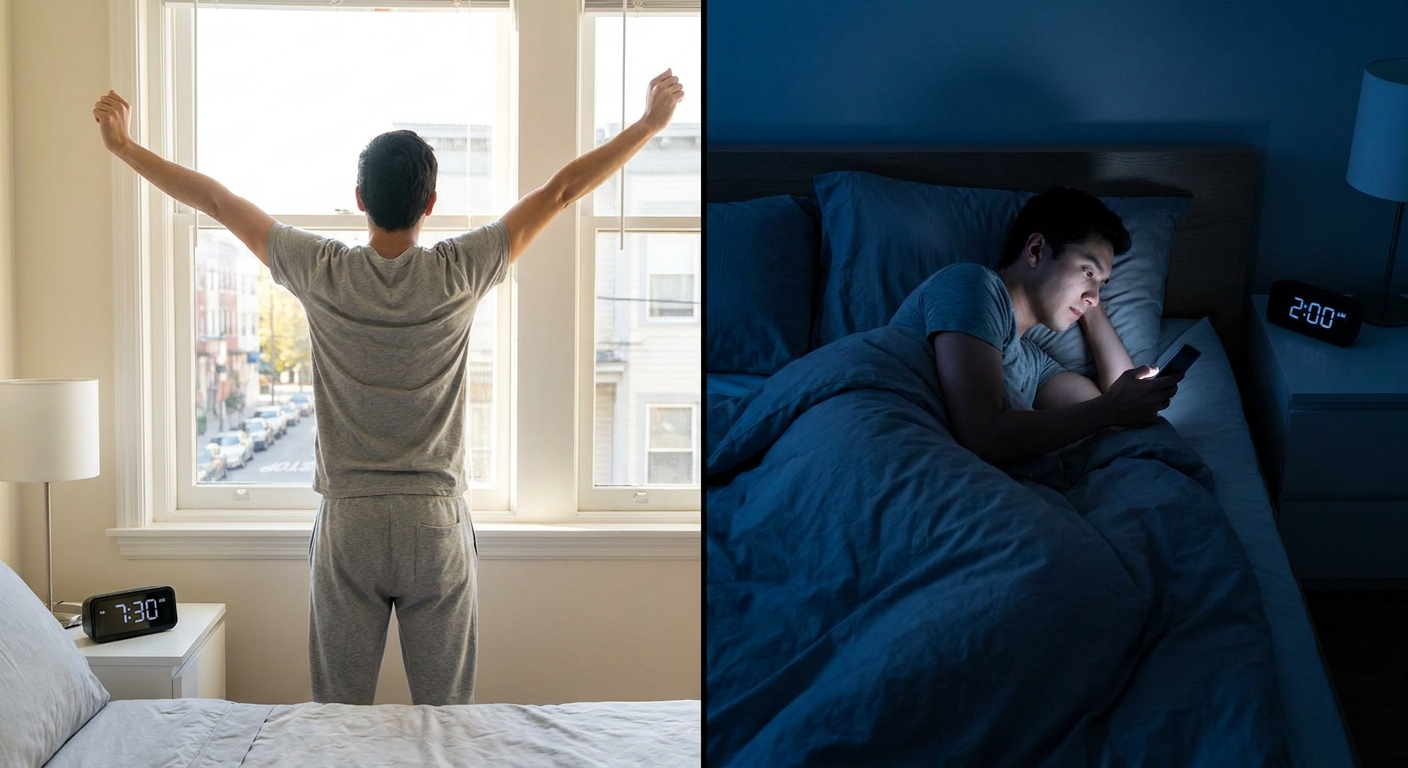
- Spending at least 30 minutes outdoors, especially in the morning.
- Positioning your desk near a window.
- Keeping indoor lights bright and, during working hours, cool-toned.
Research shows that robust daytime light exposure improves nighttime sleep quality, shortens time to fall asleep, and stabilizes circadian phase.[^3]
Night-time Light: The Unexpected Floodlight
In contrast, bright or blue-enriched light at night can disrupt your internal night.
Night-time habits that hinder:
- Using laptops, phones, or tablets close to your face in the hour before bed.
- Leaving overhead lights blazing late into the evening.
- Sleeping with televisions or bright LEDs on in the room.
Even modest evening light can suppress melatonin and delay sleep onset.[^4] One study found that reading on a light-emitting eReader before bed shifted circadian timing and reduced next-morning alertness compared to reading a paper book.[^5]
A calmer approach:
- For the last 1–2 hours before bed, dim lights and use warm, low-intensity lamps.
- Enable night modes on devices or, better yet, shift to non-screen activities.
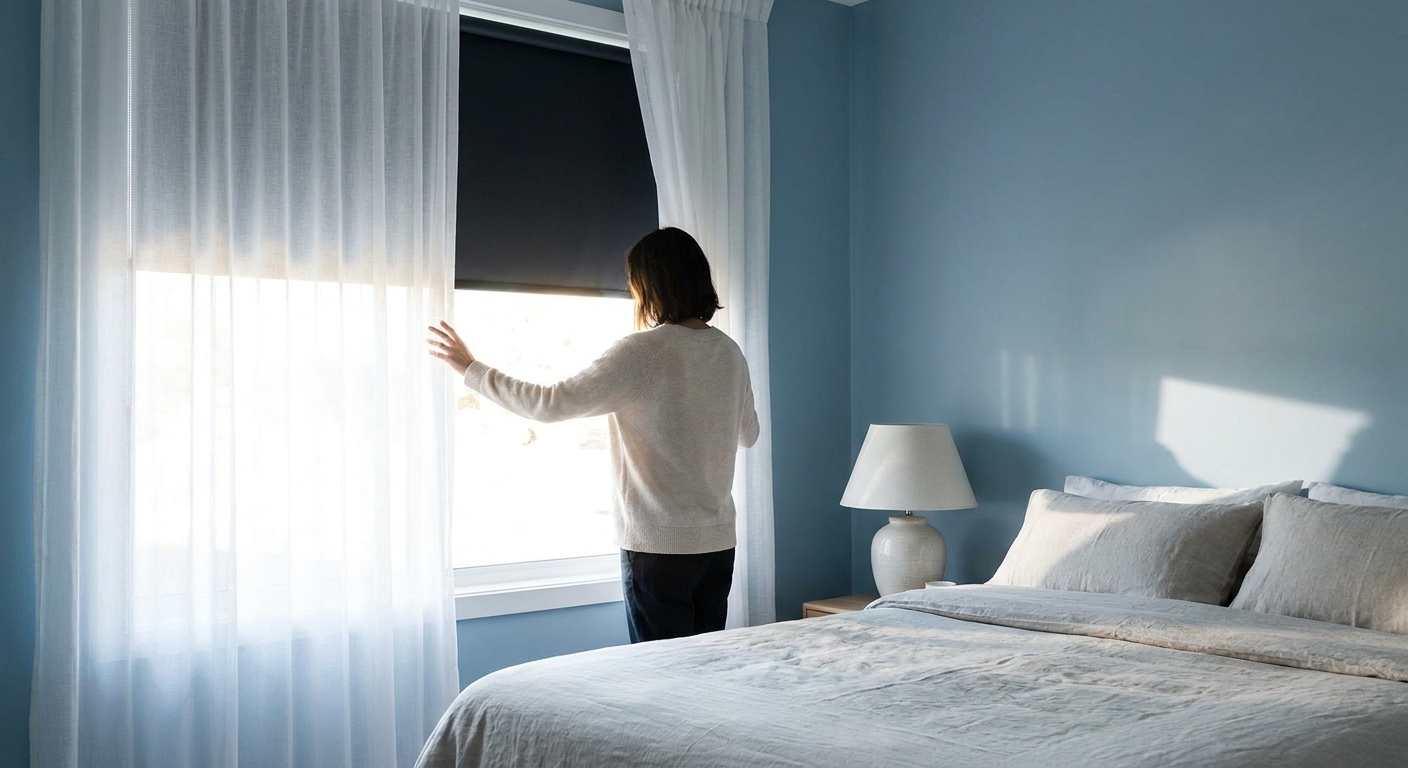
- In the bedroom, cover small light sources and use blackout curtains or masks to preserve darkness.
Day vs. Night: Activity and Rest
Daytime Activity: Setting the Tempo
Physical activity is a gentle but important cue for circadian alignment.
Helpful daytime patterns:
- Engaging in moderate exercise (walking, yoga, cycling) most days, especially earlier.
- Doing more cognitively demanding tasks when you naturally feel most alert, which aligns with your chronotype.
Regular exercise is associated with better sleep quality and more consolidated sleep, particularly when done earlier in the day.[^6]
Night-time Stillness: Softening the Rhythm
In the evening, your body benefits from a gradual downshift.
Night-time patterns that can disturb:
- Intense exercise late in the evening, which may delay sleep in some people.
- Highly stimulating mental work or emotionally activating media shortly before bed.
Instead, consider:
- Gentle stretching or breathing exercises.
- Low-key tasks like tidying, preparing clothes for the next day, or light reading.
In the bedroom, think of movement gently tapering: a slower pace, softer sounds, and fewer demands.
Day vs. Night: Meals and Metabolism
Daytime Eating: Fueling the Active Phase
Your digestive system also runs on a rhythm. Eating the bulk of your calories earlier aligns better with metabolic processes.[^7]
Supportive daytime eating habits:
- Eating breakfast within a few hours of waking to signal the start of your active phase.
- Consuming larger meals earlier in the day when possible.
Night-time Eating: Asking Your System to Work Overtime
Eating large, heavy meals just before sleep sends mixed signals: your gut gears up while your brain prepares to wind down.
Research links late-night eating with poorer sleep and metabolic disruption, especially when it becomes a pattern.[^7]
Gentler nighttime approach:
- Aim to finish your main meal 2–3 hours before bed.
- If you need a snack closer to bedtime, choose something light and simple.
The Bedroom as the Night Half of the Dance
Your bedroom is where your night-time cues gather and begin to outweigh the day. Small design changes can powerfully reinforce this shift.
Light and Darkness in the Bedroom
Aim for:
- Darkness at night – blackout curtains, sleep masks, covered LEDs.
- Soft light sources – bedside lamps with warm bulbs, salt lamps, or candles (used safely), instead of bright overhead fixtures.
Temperature and Texture
- Maintain a cool environment (around 60–67°F / 15–19°C).[^8]
- Choose breathable bedding; think of your bed as a nest that holds warmth without trapping heat.
Sound and Sight
- Use white noise or gentle sounds if external noise is an issue.
- Keep the visual field calm: minimal clutter, soothing colors, no glaring screens.
The bedroom’s job is singular: to tell your senses and your circadian system, this is where the day ends.
Chronotype-Specific Day vs. Night Strategies
Your natural timing influences how you should lean into or soften certain day and night habits.
Morning Types (Larks)
By day:
- Place complex tasks and key decisions in the morning, when alertness naturally peaks.
- Get outdoor light early, but if you’re waking too early, you might delay strong light by 30–60 minutes.
By night:
- Avoid making evenings too dim, too early; use moderate, warm lighting until close to your intended bedtime.
- If early sleepiness intrudes, consider modestly stimulating but not arousing activities—light reading, conversation, or crafts.
Intermediate Types (Hummingbirds)
By day:
- Maintain a consistent pattern: similar wake times and meal times across the week.
- Use mid-morning or early afternoon for demanding work.
By night:
- Create a dependable wind-down window—say, 10–11 p.m.—with dim light and calming rituals.
- Keep bedroom lighting and temperature routines the same each night to reinforce stable timing.
Evening Types (Owls)
By day:
- Seek strong morning light; this is often the single most important tool for owls.[^3]
- If possible, schedule strenuous exercise earlier, which can help advance circadian phase.
By night:
- Begin the dimming process early—2 hours before your desired bedtime, not your current one.
- Avoid very bright screens in bed; consider audio content or paper books with warm, low light.
Bringing the Dance into Balance
The contrast between how you treat your days and nights is the language your circadian system understands. Bright days paired with dim, quiet nights tell a clear story; dim days and bright, busy nights blur the boundaries.
You do not need to change everything at once. Start with one small contrast:
- Brighter, more intentional morning light
- Slightly dimmer lamps in the hour before bed
- One new calming bedroom ritual that you repeat each night
Over time, these refined steps become a practiced dance. Your inner clock learns the pattern, your evenings gently soften, and sleep becomes less of a struggle and more of a natural closing of the day.
Allow your habits to move like tides: energetic but contained during the day, slow and intentional at night. Your circadian system will meet you there, finding its way back into rhythm.
References
[^1]: Hastings MH, Reddy AB, Maywood ES. A clockwork web: circadian timing in brain and periphery, in health and disease. Nat Rev Neurosci. 2003.
[^2]: Dijk DJ, Czeisler CA. Contribution of the circadian pacemaker and the sleep homeostat to sleep propensity, structure, and EEG power density. J Neurosci. 1995.
[^3]: Hébert M et al. The effects of prior light history on the suppression of melatonin by light in humans. J Pineal Res. 2002.
[^4]: Cho CH et al. Effects of artificial light at night on human health: A literature review of observational and experimental studies. Chronobiol Int. 2015.
[^5]: Chang AM et al. Evening use of light-emitting eReaders negatively affects sleep, circadian timing, and next-morning alertness. PNAS. 2015.
[^6]: Kredlow MA, Capozzoli MC, Hearon BA, Calkins AW, Otto MW. The effects of physical activity on sleep: a meta-analytic review. J Behav Med. 2015.
[^7]: Garaulet M, Gómez-Abellán P. Timing of food intake and obesity: a novel association. Physiol Behav. 2014.
[^8]: Okamoto-Mizuno K, Mizuno K. Effects of thermal environment on sleep and circadian rhythm. J Physiol Anthropol. 2012.